Share this article and save a life!
Your surgical supplies just became a national security issue.
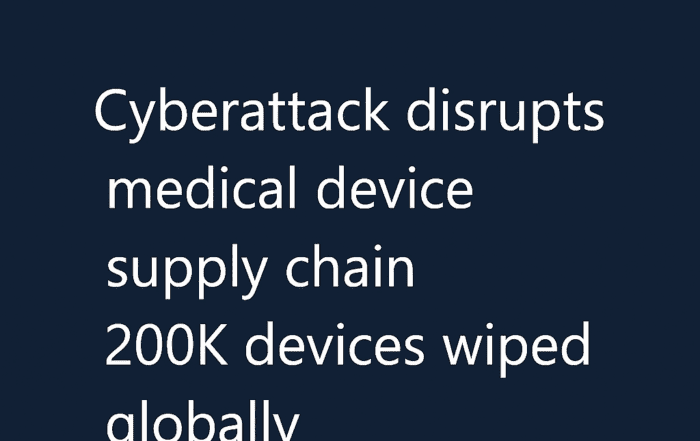
On March 11, Stryker Corporation, one of healthcare’s largest medical device suppliers, fell victim to a devastating wiper cyberattack that destroyed data across 200,000 devices globally.
The attackers didn’t want money. They wanted chaos.
Here’s what happened:
The pro-Iran hacktivist group Handala exploited Microsoft Intune to wipe Stryker’s systems clean. Manufacturing halted. Shipping stopped. Orders couldn’t be processed. Hospitals suddenly faced uncertainty about their medical device supply chain.
50 TB of data was exfiltrated before the wipe.
Think about that for a moment.
Stryker supplies critical surgical tools, orthopedic implants, and medical equipment to thousands of hospitals. When their systems went dark, it wasn’t just an IT problem, it was a patient care problem waiting to happen.
The American Hospital Association is monitoring for ripple effects. CISA launched an investigation. Why? Because Stryker has contracts with the DoD and VA. This isn’t just corporate disruption, it’s critical infrastructure under attack.
Here’s what keeps me up at night:
Our healthcare supply chain runs on trust and just-in-time delivery. One cyberattack on a major supplier can cascade through the entire system. Delayed surgeries. Missing implants. Critical procedures postponed.
We’ve built a healthcare system so efficient that it’s become fragile.
The hackers didn’t target a hospital directly. They targeted the company that hospitals depend on. That’s the new playbook: hit the suppliers, disrupt the entire ecosystem.
Every medical device company is now a potential target. Every supply chain connection is a vulnerability. Every vendor relationship carries cyber risk.
Healthcare leaders, ask yourself:
• Do you have backup suppliers for critical devices?
• Can you operate if your primary vendor goes dark for weeks?
• Have you stress-tested your supply chain for cyber disruptions?
This attack proves that healthcare cybersecurity isn’t just about protecting patient data anymore. It’s about protecting the entire care delivery infrastructure.
The next cyberattack might not hit your hospital directly. But it could still leave your OR without the tools it needs.
♻️ Repost if healthcare supply chains need cyber resilience plans
👉 Follow me, Jonathan Govette, for daily, real-time updates on healthcare technology and business news. LinkedIn Profile: https://www.linkedin.com/in/jonathangovette/
Share this article and save a life!
Author:

Jonathan Govette is a seasoned healthcare and technology executive with more than two decades of experience building, scaling, and advising digital health companies. He is the Co-Founder and CEO of Oatmeal Health, an AI-driven Lung Cancer Screening and Diagnostics company focused on expanding access to early detection for underrepresented populations, particularly patients served by Federally Qualified Health Centers and value-based health plans.
With a background in engineering, product development, and strategic partnerships, Jonathan has founded and led multiple health technology ventures across clinical care delivery, regulated medical software, and AI-enabled diagnostics. His work sits at the intersection of medicine, technology, and health equity, with a consistent focus on translating complex clinical problems into scalable, real-world solutions.
Jonathan has spent much of his professional life dedicated to improving outcomes for marginalized and underserved communities. He has designed and implemented frameworks that align clinical quality, reimbursement, and technology to sustainably advance health equity at scale. This mission is deeply personal and informs his leadership philosophy and long-term vision for healthcare transformation.
In addition to his operating experience, Jonathan is an author and long-time writer in the healthcare domain, with over 20 years of published work covering digital health, medical innovation, and healthcare systems. He is a frequent mentor to early-stage founders and regularly advises startups on product strategy, partnerships, and go-to-market execution in regulated healthcare environments.
Before entering industry full-time, Jonathan nearly pursued a career in medicine with an early path toward cardiothoracic surgery, an experience that continues to shape his clinical perspective and respect for frontline care delivery.
CEO | Oatmeal Health | AI Lung Cancer Startup | Engineer | Writer | Almost Became a Doctor (Cardiac Thoracic Surgeon) | 3x Health Tech Founder | Startup Mentor | Follow to share what I’ve learned along the way.