Share this article and save a life!
I keep thinking about this headline from this week.
“New Rural Health Funding Only a Bandage for Medicaid Wound.”
That is not hyperbole. That is the operating reality for every FQHC and community health center in this country right now.
Here is what is actually happening. 🧵
Congress is promoting a $50 billion Rural Health Transformation Program. That number sounds enormous. It gets press. It gets applause.
But buried in the same legislative package is a proposed $35 billion cut to the HRSA Community Health Center Fund over 10 years. That is the Section 330 grant program. It is not a fringe line item. It is the foundational operating support that keeps the doors open at health centers serving 32 million patients across the country.
This is not a tradeoff. It is a shell game.
FQHCs do not run on optimism. They run on Section 330 grants, Medicaid reimbursements, and 340B savings. Pull any one of those three legs and the stool collapses. Pull two at the same time and you are not talking about service reductions. You are talking about closures.
And right now, all three legs are under pressure simultaneously.
Medicaid cuts in the same bill will reduce per-patient revenue for health centers whose patient panels are 40, 50, sometimes 70 percent Medicaid. The $35 billion Section 330 reduction compounds that directly. And 340B has been a policy battleground for years.
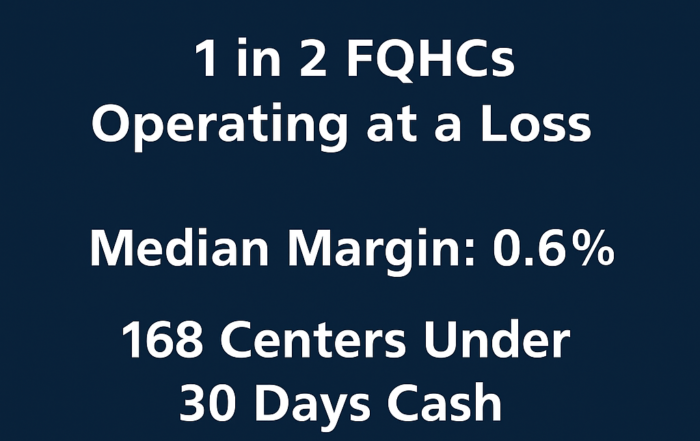
Health center CEOs are not sitting in boardrooms with cushions. They are running 55 percent cost-to-revenue ratios, managing clinical staff shortages, and making payroll decisions week to week. A $50 billion headline does not change that math if the underlying funding mechanisms are being hollowed out.
What most people outside this space miss is how little room these organizations have to absorb shocks. There is no rainy day fund. There is no capital reserve built up over decades of margin. When a rural health center in Indiana or New Hampshire loses 15 percent of its Medicaid reimbursement, that is not a budget adjustment. That is a staffing decision the next week. 🏥
The communities these centers serve have no alternative. No private practice is coming to replace them. No urgent care chain is going to open in a rural county with a median income under $35,000.
A bandage on a Medicaid wound does not heal the patient. It just makes the press release look better.
FQHC medical directors and CFOs are worth more than a headline.
If you run a community health center, which funding leg are you most worried about losing first, and has your board had an honest conversation about what closure contingency planning actually looks like?
👉 Follow for daily healthcare insights. Deeper dives in The Oatmeal Bite on Substack.
Share this article and save a life!
Author:
CEO/Co-Founder @ Oatmeal Health | AI Lung Cancer Screening | Almost Became a Doctor | Engineer | Follow to Share What I’ve Learned Along the Way
I help patients get the care they need earlier, preventing late-stage cancer.
That’s been the throughline across three companies and almost 20 years in healthcare. At ReferralMD, we fixed broken referral networks so patients didn’t fall through the cracks. At Oatmeal Health, it’s lung cancer: building the diagnostic and screening infrastructure so the 85% of cases caught too late get caught early instead.
Today as CEO of Oatmeal Health, I lead a team embedding AI into radiology workflows to turn routine lung CT scans into reimbursable cancer risk assessments. We partner with FQHCs to reach underserved communities, and with health systems and payers to make early detection economically sustainable. Think HeartFlow or Cleerly, but for lungs.
Between companies, I advised at Techstars and Plug and Play, mentoring founders building in digital health. That experience shaped how I think about what separates companies that ship from companies that stall: distribution, reimbursement, and clinical trust, not just technology.
I’m a CancerX alumnus, a 3x healthcare founder, and someone who believes the biggest problems in cancer aren’t scientific. They’re operational.
We’re hiring mission-driven builders at Oatmeal Health. If you want to work on something that matters, reach out.
When I’m not working, I’m traveling, mentoring, and keeping up with one very energetic husky. 🐾
Substack – The Oatmeal Bite:
Millions of patients get less care because of who they are, where they live, or how they look. I’m fighting to change that. CEO @OatmealHealth, a startup built for the underserved. The Oatmeal Bite: intel for clinicians, investors, and advocates.
Jonathan Govette
CEO of Oatmeal Health
Substack:
https://oatmealhealthjonathangovette.substack.com/