Share this article and save a life!
More radiation on top of immunotherapy should help. It didn’t. 🎯
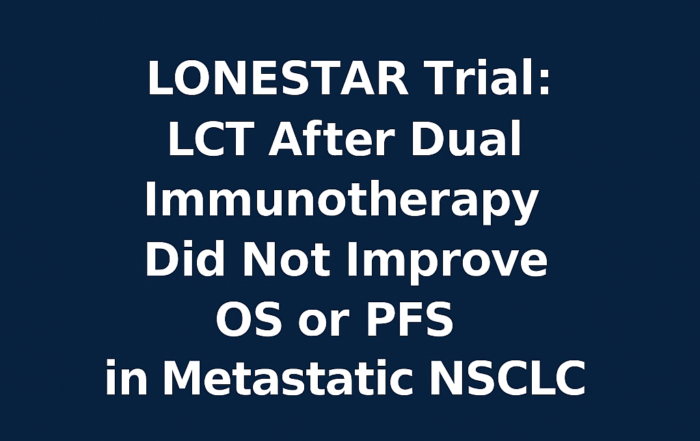
The LONESTAR trial just changed how we should think about local consolidative therapy in metastatic NSCLC.
For years, the logic seemed airtight. Debulk residual tumor with radiation or surgery after immunotherapy induction, and systemic disease control should follow. It worked in chemo settings. It felt like a natural extension.
But according to News-Medical, results presented at the IASLC 2026 World Conference on Lung Cancer told a different story.
The LONESTAR framework forces you to ask six questions before adding LCT to dual checkpoint blockade.
1. What induction regimen was used?
LONESTAR studied nivolumab plus ipilimumab as the induction backbone. The negative result applies specifically to dual checkpoint blockade, not to every immunotherapy context.
2. Did the patient progress during induction?
Only patients without progression or dose-limiting toxicity after 12 weeks of induction were randomized. If a patient progressed on induction, the LCT question is moot.
3. Is the disease truly oligometastatic?
🔹 77 of 166 randomized patients had oligometastatic disease at randomization.
🔹 LCT still did not improve OS or PFS even in this subgroup.
🔹 The oligometastatic benefit assumption does not automatically transfer from chemo-era data to immunotherapy-era data.
4. What does LCT actually add in this context?
The trial included 83 patients in the LCT arm. Of those, 71 received radiation to at least one disease site and 16 underwent surgery. The intervention was real. The benefit was not.
5. What is the toxicity trade-off?
Adding radiation or surgery carries procedural burden. According to Dr. Mehmet Altan of MD Anderson, adding LCT after induction dual checkpoint blockade was feasible, but it did not improve overall survival or progression-free survival in the overall population or among patients with oligometastatic disease.
6. What does the null result actually mean for practice?
It does not mean LCT is never useful. It means the assumption that LCT adds systemic control on top of active dual immunotherapy is no longer supported by Phase III evidence in this setting.
Save this before your next tumor board. The conversation about consolidative radiation and surgery in metastatic NSCLC is going to look different this fall.
🔹 LONESTAR: Phase III, open-label, single-center, randomized
🔹 166 patients total, 83 per arm
🔹 Induction: 12 weeks of nivolumab plus ipilimumab
🔹 LCT arm: radiation to at least one site, surgery when feasible
🔹 Result: no OS or PFS improvement, overall or oligometastatic
🔹 Presented: IASLC WCLC 2026, September 12, 2026
The immune system, when activated by dual checkpoint blockade, may already be doing the work we assumed radiation had to finish.
The paradigm is not dead. It is being rewritten in real time.
👉 Follow Jonathan Govette, CEO of Oatmeal Health, for daily healthcare insights on LinkedIn. Deeper dives in The Oatmeal Bite on Substack: https://news.oatmealhealth.com
Share this article and save a life!
Author:
CEO/Co-Founder @ Oatmeal Health | AI Lung Cancer Screening | Almost Became a Doctor | Engineer | Follow to Share What I’ve Learned Along the Way
I help patients get the care they need earlier, preventing late-stage cancer.
That’s been the throughline across three companies and almost 20 years in healthcare. At ReferralMD, we fixed broken referral networks so patients didn’t fall through the cracks. At Oatmeal Health, it’s lung cancer: building the diagnostic and screening infrastructure so the 85% of cases caught too late get caught early instead.
Today as CEO of Oatmeal Health, I lead a team embedding AI into radiology workflows to turn routine lung CT scans into reimbursable cancer risk assessments. We partner with FQHCs to reach underserved communities, and with health systems and payers to make early detection economically sustainable. Think HeartFlow or Cleerly, but for lungs.
Between companies, I advised at Techstars and Plug and Play, mentoring founders building in digital health. That experience shaped how I think about what separates companies that ship from companies that stall: distribution, reimbursement, and clinical trust, not just technology.
I’m a CancerX alumnus, a 3x healthcare founder, and someone who believes the biggest problems in cancer aren’t scientific. They’re operational.
We’re hiring mission-driven builders at Oatmeal Health. If you want to work on something that matters, reach out.
When I’m not working, I’m traveling, mentoring, and keeping up with one very energetic husky. 🐾
Substack – The Oatmeal Bite:
Millions of patients get less care because of who they are, where they live, or how they look. I’m fighting to change that. CEO @OatmealHealth, a startup built for the underserved. The Oatmeal Bite: intel for clinicians, investors, and advocates.
Jonathan Govette
CEO of Oatmeal Health
Substack:
https://oatmealhealthjonathangovette.substack.com/