Share this article and save a life!
CFO, are you paying for a law that was supposed to protect your employees? 💥
Because that is exactly what is happening right now.
This week, a coalition of 67 health care industry and advocacy groups sent a letter to congressional leadership calling the No Surprises Act arbitration process a “massive unforeseen crisis in employer-sponsored coverage.” Those words belong to Melissa Bartlett, senior vice president for health policy at the ERISA Industry Committee. She is not a fringe voice. She speaks for the people managing the benefits your employees depend on.
Here is what went wrong.
The No Surprises Act, passed in 2020, did something genuinely good. It shielded patients from getting blindsided by out-of-network bills. That part worked. But the law also created a “baseball-style” arbitration system to settle payment disputes between providers and insurers when no contract exists. Each side names a price. An arbitrator picks one. No middle ground.
Arbitration was supposed to be the rare exception.
It is now the default. And providers are winning consistently, according to Roll Call.
🔹 Providers are receiving payouts averaging over six times the local in-network rates.
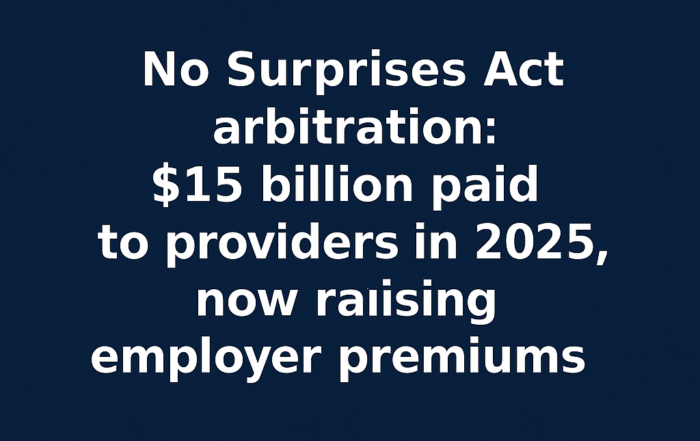
🔹 Providers secured an additional $15 billion in arbitration payments in 2025 alone.
🔹 Health policy analysts have found the payouts are contributing to higher premiums for both employers and employees.
That $15 billion does not vanish. It flows directly into your benefits costs and your employees’ paychecks. The law fixed one crisis and silently created another.
The counterpoint is fair. Providers argue that in-network rates are artificially suppressed by payer leverage, and that arbitration is the only correction mechanism available. Some of that argument has merit. But a system where arbitration has become routine rather than a last resort, and where payouts average over six times local in-network rates, is no longer a correction mechanism. It is a revenue strategy.
Congress is finally moving. Senate HELP Chair Bill Cassidy plans a roundtable. Rep. Frank Pallone Jr. is scrutinizing the arbitration firms themselves. House Ways and Means Republicans are looking at the cost spiral.
But legislative roundtables move slowly. Premiums do not wait.
Here is what I keep coming back to. Health policy is almost never a clean win. The No Surprises Act protected millions of patients from financial ruin at the point of care, and that matters. But when the solution to one crisis becomes the engine of another, the system owes it to everyone in the room, patients, employers, and providers alike, to get honest about what is actually happening. Right now, the arbitration market is not honest. It is a $15 billion signal that something is broken, and the people paying the price are the ones we said we were trying to protect.
👉 Follow Jonathan Govette, CEO of Oatmeal Health, for daily healthcare insights on LinkedIn. Deeper dives in The Oatmeal Bite on Substack: https://news.oatmealhealth.com
Share this article and save a life!
Author:
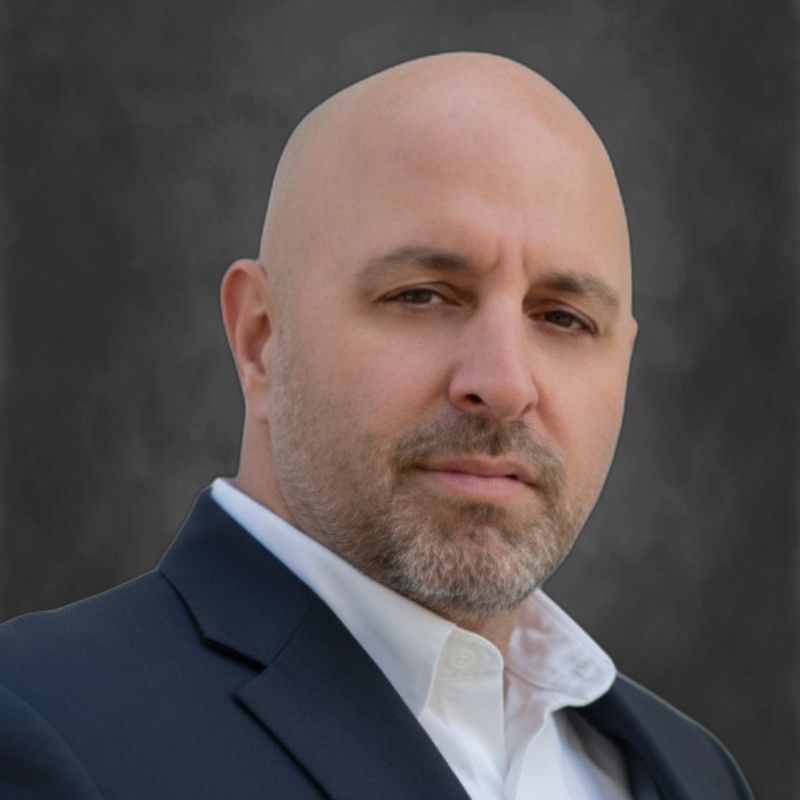
CEO/Co-Founder @ Oatmeal Health | AI Lung Cancer Screening | Almost Became a Doctor | Engineer | Follow to Share What I’ve Learned Along the Way
I help patients get the care they need earlier, preventing late-stage cancer.
That’s been the throughline across three companies and almost 20 years in healthcare. At ReferralMD, we fixed broken referral networks so patients didn’t fall through the cracks. At Oatmeal Health, it’s lung cancer: building the diagnostic and screening infrastructure so the 85% of cases caught too late get caught early instead.
Today as CEO of Oatmeal Health, I lead a team embedding AI into radiology workflows to turn routine lung CT scans into reimbursable cancer risk assessments. We partner with FQHCs to reach underserved communities, and with health systems and payers to make early detection economically sustainable. Think HeartFlow or Cleerly, but for lungs.
Between companies, I advised at Techstars and Plug and Play, mentoring founders building in digital health. That experience shaped how I think about what separates companies that ship from companies that stall: distribution, reimbursement, and clinical trust, not just technology.
I’m a CancerX alumnus, a 3x healthcare founder, and someone who believes the biggest problems in cancer aren’t scientific. They’re operational.
We’re hiring mission-driven builders at Oatmeal Health. If you want to work on something that matters, reach out.
When I’m not working, I’m traveling, mentoring, and keeping up with one very energetic husky. 🐾
Substack – The Oatmeal Bite:
Millions of patients get less care because of who they are, where they live, or how they look. I’m fighting to change that. CEO @OatmealHealth, a startup built for the underserved. The Oatmeal Bite: intel for clinicians, investors, and advocates.
Jonathan Govette
CEO of Oatmeal Health
Substack:
https://oatmealhealthjonathangovette.substack.com/