Share this article and save a life!
America’s safety net clinics can’t afford the AI revolution.
And that should alarm every healthcare leader reading this.
FQHCs serve more than 32 million patients across the United States. Over 90% of those patients are low-income, uninsured, or on Medicaid. They represent the communities that face the highest burden of preventable disease, delayed diagnosis, and chronic illness.
But here is what is not being talked about enough:
While major health systems are deploying ambient AI scribes, automated prior auth tools, and AI-powered diagnostic imaging, most FQHCs are still running on outdated EHR infrastructure, limited broadband, and IT teams of one.
The digital health gap is not just a technology problem. It is a health equity crisis in slow motion.
Consider what community health centers are up against:
– Many FQHCs use EHR systems that do not support modern API integrations, making AI add-ons impossible without expensive upgrades
– Broadband access at rural and frontier health centers remains inconsistent, which directly limits cloud-based clinical tools
– HRSA’s Health Center Fund does not include a dedicated technology modernization allocation
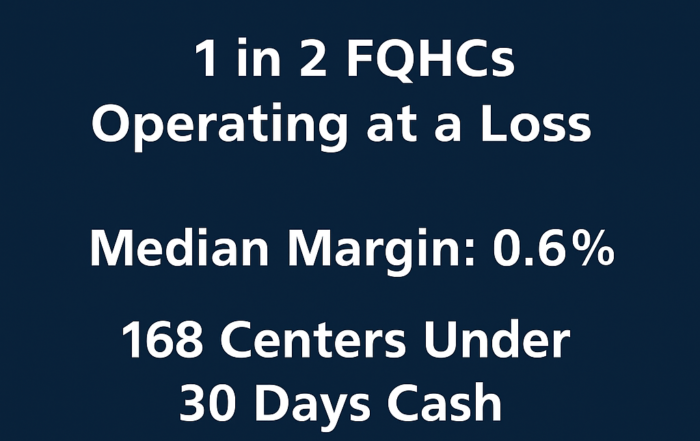
– Vendor contracts are priced for large health systems, not lean federally qualified health centers operating on razor-thin margins
This is not hypothetical risk. It is already happening.
As AI tools reduce documentation time, flag high-risk patients earlier, and improve diagnostic accuracy at well-resourced hospitals, patients at FQHCs are falling further behind, not because their providers do not want better tools, but because the financial structure simply does not support adoption.
So what would actually move the needle?
A few ideas worth debating:
1. A dedicated federal technology modernization fund specifically for FQHCs, similar to the HITECH Act investments that pushed EHR adoption in the early 2010s.
2. Sliding-scale vendor pricing models that tier costs based on payer mix and patient volume, not just market size.
3. HRSA-backed shared services infrastructure, where FQHCs in a region share AI tools, IT support, and data infrastructure under a cooperative model.
4. Policy language in future reconciliation bills that explicitly protects and funds digital health equity for community health centers.
The innovation happening in health systems right now is genuinely exciting. AI is improving outcomes. Automation is reducing burnout. Early detection is saving lives.
But if those gains only reach patients with commercial insurance or access to large academic medical centers, we have not advanced healthcare. We have just made the gap more sophisticated.
FQHC leaders are doing extraordinary work with limited resources. They deserve technology that matches their mission.
The question is not whether AI belongs in community health. The question is whether we are willing to build the infrastructure to get it there.
♻️ Repost if every patient, regardless of zip code or insurance status, deserves access to the same life-saving technology.
👉 Follow me for daily, real-time updates on healthcare technology and business news.
Share this article and save a life!
Author:
CEO/Co-Founder @ Oatmeal Health | AI Lung Cancer Screening | Almost Became a Doctor | Engineer | Follow to Share What I’ve Learned Along the Way
I help patients get the care they need earlier, preventing late-stage cancer.
That’s been the throughline across three companies and almost 20 years in healthcare. At ReferralMD, we fixed broken referral networks so patients didn’t fall through the cracks. At Oatmeal Health, it’s lung cancer: building the diagnostic and screening infrastructure so the 85% of cases caught too late get caught early instead.
Today as CEO of Oatmeal Health, I lead a team embedding AI into radiology workflows to turn routine lung CT scans into reimbursable cancer risk assessments. We partner with FQHCs to reach underserved communities, and with health systems and payers to make early detection economically sustainable. Think HeartFlow or Cleerly, but for lungs.
Between companies, I advised at Techstars and Plug and Play, mentoring founders building in digital health. That experience shaped how I think about what separates companies that ship from companies that stall: distribution, reimbursement, and clinical trust, not just technology.
I’m a CancerX alumnus, a 3x healthcare founder, and someone who believes the biggest problems in cancer aren’t scientific. They’re operational.
We’re hiring mission-driven builders at Oatmeal Health. If you want to work on something that matters, reach out.
When I’m not working, I’m traveling, mentoring, and keeping up with one very energetic husky. 🐾
Substack – The Oatmeal Bite:
Millions of patients get less care because of who they are, where they live, or how they look. I’m fighting to change that. CEO @OatmealHealth, a startup built for the underserved. The Oatmeal Bite: intel for clinicians, investors, and advocates.
Jonathan Govette
CEO of Oatmeal Health
Substack:
https://oatmealhealthjonathangovette.substack.com/