Share this article and save a life!
FQHCs don’t just need funding. They need patients with coverage.
And the Senate reconciliation bill threatens both at the same time.
Most of the conversation around the “Big Beautiful Bill” has focused on specific line items: 340B savings, DSH payments, Section 330 grants. But there is a quieter provision getting far less attention, and it may be the most structurally damaging of all.
Medicaid enrollment caps and per capita spending limits.
Here is why that matters for community health centers specifically.
FQHCs generate roughly 40 to 50 percent of their revenue from Medicaid patients. That is not a footnote. That is the foundation of the business model. When Medicaid enrollment shrinks, FQHC patient volume shrinks with it. And when volume drops, the prospective payment system that FQHCs depend on stops working the way it was designed.
Per capita caps work by setting a ceiling on how much the federal government will pay per enrollee. States that exceed that ceiling absorb the difference. In practice, states facing budget pressure do not absorb it. They cut benefits, restrict eligibility, or both.
For patients at FQHCs, that means fewer people qualify. For FQHCs, that means fewer billable visits. For communities that already have one or zero providers within 30 miles, that means a primary care desert gets deeper.
The numbers tell a blunt story. KFF estimates that Medicaid enrollment caps paired with eligibility redetermination acceleration could reduce enrollment by 4 to 7 million adults over the next decade, depending on final bill language. These are not edge cases. These are the exact patients FQHCs were created to serve.
And here is the operational reality that rarely makes the headlines.
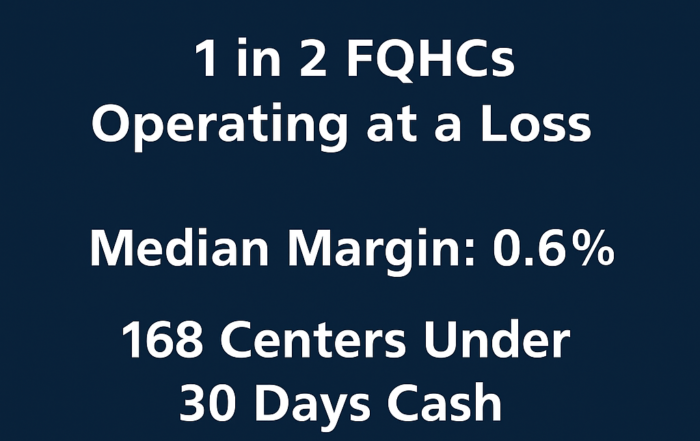
FQHCs are not hospitals with reserve funds. The median FQHC operates on margins below 2 percent. A 10 to 15 percent drop in Medicaid volume does not trigger a board-level strategic review. It triggers layoffs, site closures, and service line cuts.
The irony is painful. Congress designed the FQHC model specifically to reduce long-term healthcare costs by keeping underserved patients connected to primary care and out of emergency departments. Cutting Medicaid enrollment to save money in the short term may actually drive up emergency utilization costs on the other side.
This is the fiscal paradox hiding inside the per capita cap debate.
What should FQHC leaders be doing right now?
First, model the enrollment impact. Work with your finance team to build a scenario where Medicaid volume drops 10, 15, and 20 percent. Know your break-even point before you need it.
Second, diversify revenue. Uninsured sliding-scale revenue, Ryan White funding, and value-based care arrangements are not backup plans. In this environment, they are primary strategy.
Third, engage your state Medicaid office. States will have significant discretion in how they implement per capita caps. FQHC leaders who are at the table during state implementation planning will have far better outcomes than those reacting after the fact.
The conversation about reconciliation and community health has been almost entirely reactive. That has to change.
FQHCs that survive the next three years will be the ones that treated policy uncertainty as an operational planning input, not a news headline.
♻️ Repost if your community health center deserves a seat at the table before the cuts, not after.
👉 Follow me for daily healthcare updates and get the deeper analysis in my free newsletter → https://lnkd.in/eJKFuB_p
Share this article and save a life!
Author:
CEO/Co-Founder @ Oatmeal Health | AI Lung Cancer Screening | Almost Became a Doctor | Engineer | Follow to Share What I’ve Learned Along the Way
I help patients get the care they need earlier, preventing late-stage cancer.
That’s been the throughline across three companies and almost 20 years in healthcare. At ReferralMD, we fixed broken referral networks so patients didn’t fall through the cracks. At Oatmeal Health, it’s lung cancer: building the diagnostic and screening infrastructure so the 85% of cases caught too late get caught early instead.
Today as CEO of Oatmeal Health, I lead a team embedding AI into radiology workflows to turn routine lung CT scans into reimbursable cancer risk assessments. We partner with FQHCs to reach underserved communities, and with health systems and payers to make early detection economically sustainable. Think HeartFlow or Cleerly, but for lungs.
Between companies, I advised at Techstars and Plug and Play, mentoring founders building in digital health. That experience shaped how I think about what separates companies that ship from companies that stall: distribution, reimbursement, and clinical trust, not just technology.
I’m a CancerX alumnus, a 3x healthcare founder, and someone who believes the biggest problems in cancer aren’t scientific. They’re operational.
We’re hiring mission-driven builders at Oatmeal Health. If you want to work on something that matters, reach out.
When I’m not working, I’m traveling, mentoring, and keeping up with one very energetic husky. 🐾
Substack – The Oatmeal Bite:
Millions of patients get less care because of who they are, where they live, or how they look. I’m fighting to change that. CEO @OatmealHealth, a startup built for the underserved. The Oatmeal Bite: intel for clinicians, investors, and advocates.
Jonathan Govette
CEO of Oatmeal Health
Substack:
https://oatmealhealthjonathangovette.substack.com/