Share this article and save a life!
Early-stage lung cancer surgery is not the finish line. 🎯 What happens in the adjuvant setting determines whether your patient is alive eight years from now.
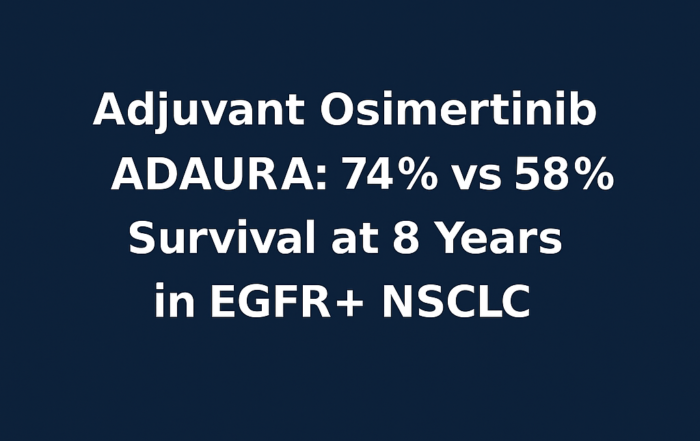
The ADAURA Phase III trial just released its 8-year exploratory survival update, and the numbers are impossible to ignore. According to MyChesCo, adjuvant osimertinib reduced the risk of death by 47% compared with placebo in Stage II to IIIA EGFR-mutated NSCLC patients. That is the trial’s primary population.
Here is what that looks like in plain terms.
Stage II-IIIA population (primary):
🔹 74% of Tagrisso-treated patients were alive at 8 years
🔹 58% of placebo patients were alive at 8 years
🔹 Hazard ratio: 0.53 (95% CI 0.38 to 0.75)
Broader Stage IB-IIIA population:
🔹 79% alive at 8 years with Tagrisso
🔹 64% alive at 8 years with placebo
🔹 Hazard ratio: 0.52 (95% CI 0.39 to 0.71), a 48% death risk reduction
This is not incremental. These are 15- and 16-percentage-point absolute survival differences at eight years.
So why does this matter as a framework for your tumor board?
Because the ADAURA result forces four specific decisions every multidisciplinary team must now get right.
1. BIOMARKER FIRST. Adjuvant osimertinib only applies to EGFR-mutated disease. If your thoracic surgery program is not reflexively testing all resected Stage IB-IIIA NSCLC specimens for EGFR mutation status, you are creating a care gap before the patient even sees medical oncology.
2. STAGING PRECISION. The survival gap between Stage II-IIIA and Stage IB matters for treatment intensity conversations. Radiology and pathology need to be aligned on staging accuracy before the tumor board convenes.
3. TREATMENT DURATION COMMITMENT. Adjuvant osimertinib is a three-year regimen. Tumor boards that greenlight adjuvant therapy without discussing adherence infrastructure, toxicity monitoring, and follow-up imaging cadence are setting patients up to drop off.
4. LONG-TAIL SURVEILLANCE PLANNING. Eight-year data means you are managing a patient relationship across nearly a decade. Survivorship imaging protocols, pulmonary function tracking, and recurrence surveillance need to be defined at the time of adjuvant initiation, not reactively.
💡 The practical test for your team: after reviewing a resected Stage II-IIIA NSCLC case, can you answer all four questions before the patient leaves the building? If not, your workflow has a gap.
Save this post and bring it to your next thoracic tumor board as a pre-meeting checklist. It is exactly the kind of structured thinking that separates reactive case reviews from proactive cancer care programs.
The eight-year survival curve is separated and sustained. That does not happen by accident. It happens when every step from resection to adjuvant initiation to surveillance is operationalized with intention.
👉 Follow Jonathan Govette, CEO of Oatmeal Health, for daily healthcare insights on LinkedIn. Deeper dives in The Oatmeal Bite on Substack: https://news.oatmealhealth.com
Share this article and save a life!
Author:
CEO/Co-Founder @ Oatmeal Health | AI Lung Cancer Screening | Almost Became a Doctor | Engineer | Follow to Share What I’ve Learned Along the Way
I help patients get the care they need earlier, preventing late-stage cancer.
That’s been the throughline across three companies and almost 20 years in healthcare. At ReferralMD, we fixed broken referral networks so patients didn’t fall through the cracks. At Oatmeal Health, it’s lung cancer: building the diagnostic and screening infrastructure so the 85% of cases caught too late get caught early instead.
Today as CEO of Oatmeal Health, I lead a team embedding AI into radiology workflows to turn routine lung CT scans into reimbursable cancer risk assessments. We partner with FQHCs to reach underserved communities, and with health systems and payers to make early detection economically sustainable. Think HeartFlow or Cleerly, but for lungs.
Between companies, I advised at Techstars and Plug and Play, mentoring founders building in digital health. That experience shaped how I think about what separates companies that ship from companies that stall: distribution, reimbursement, and clinical trust, not just technology.
I’m a CancerX alumnus, a 3x healthcare founder, and someone who believes the biggest problems in cancer aren’t scientific. They’re operational.
We’re hiring mission-driven builders at Oatmeal Health. If you want to work on something that matters, reach out.
When I’m not working, I’m traveling, mentoring, and keeping up with one very energetic husky. 🐾
Substack – The Oatmeal Bite:
Millions of patients get less care because of who they are, where they live, or how they look. I’m fighting to change that. CEO @OatmealHealth, a startup built for the underserved. The Oatmeal Bite: intel for clinicians, investors, and advocates.
Jonathan Govette
CEO of Oatmeal Health
Substack:
https://oatmealhealthjonathangovette.substack.com/