
LungAI
An AI second opinion on every lung screening CT.
LungAI estimates the cancer risk of each detected lung nodule on low-dose CT, factoring in its change since the prior scan. Radiologists see a malignancy risk score for each nodule natively inside the PACS and CADe software they already use.
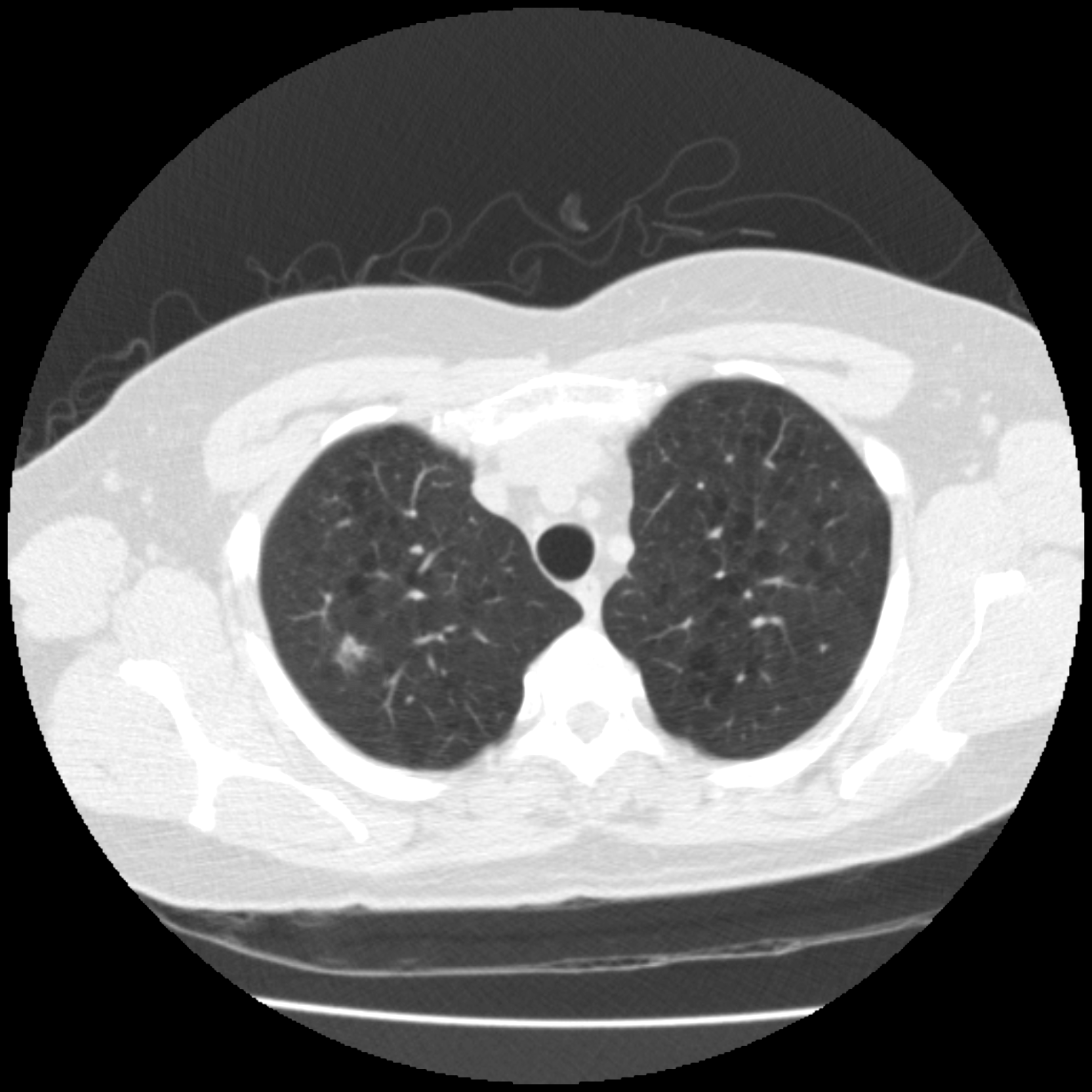
12.4 mm
No new systems for your radiologists.
No new workstation.
Scores appear inside the CADe or PACS viewer your radiologists already read in.
No new login.
Nothing extra for radiologists to open, learn, or sign in to.
No IT project.
Runs on your servers or our HIPAA-compliant cloud, with one PDF report per exam sent to PACS.
Limitations of categorical scoring
Lung-RADS is the foundation of lung cancer screening. Published literature highlights areas where categorical scoring alone leaves room for additional quantitative context.
Cancers diagnosed after a negative screen
Some cancers diagnosed within screening programs were not flagged on the initial LDCT. Borderline nodules in Lung-RADS 2 and 3 are where the clinical uncertainty is highest.
Bartlett et al., J Thorac Oncol 2021
36% of patients get a false alarm
More than one in three screened patients receive an abnormal result that turns out not to be cancer. Each false positive triggers unnecessary follow-up imaging, biopsies, and patient anxiety.
Gareen et al., Cancer 2014
29% category disagreement
Two radiologists reading the same scan assign different Lung-RADS categories nearly a third of the time. The patient's follow-up pathway depends on which radiologist reads the scan.
van Riel et al., Eur Radiol 2019
How LungAI works
A continuous score, inside the read you already do
Lung-RADS sorts nodules into a few categories. LungAI adds a probability to each one, so two nodules in the same category no longer look the same.
Step 1 · Nodule selected
Your CADe or radiologist finds the nodule
Detection stays with the tools you already use. LungAI starts from the nodules your CADe or reading physician has selected, with their size, volume, and density.
Step 2 · CADx scoring
LungAI scores each nodule, 0 to 100
The model reads the nodule, the context of the whole scan, the change since the prior exam, and basic patient history, then returns a malignancy score.
Step 3 · Report in PACS
The radiologist decides
A PDF report with the nodule image, the score, and a probability key is delivered into PACS alongside Lung-RADS. LungAI is decision support. It does not replace the read or recommend treatment.
What LungAI looks at
More than size and shape
Radiologists weigh far more than a diameter when they judge a nodule. LungAI is built to weigh the same things.
The nodule
Morphology such as margins, spiculation, and internal structure, not just diameter.
The whole scan
Context around the nodule, including lung tissue patterns such as emphysema.
The prior scan
When a prior LDCT exists, change in size, density, and shape over time feeds the score.
The patient
Age, sex, and smoking history, the same risk factors behind screening eligibility.
Validation
0.96 AUROC on held-out NLST data
LungAI was evaluated retrospectively on a held-out subset of the National Lung Screening Trial, with pathology-confirmed outcomes, at the nodule level. Clinical studies with Mass General Brigham and IQVIA are underway.
Where a continuous score changes the conversation
Four held-out NLST cases illustrating how a continuous malignancy probability differs from categorical Lung-RADS scoring. Retrospective research examples only.

10.9 mm, 619 mm³
Case 1: Elevated score on a Lung-RADS 2 nodule
Categorized Lung-RADS 2 (benign appearance, annual follow-up). In retrospective analysis, LungAI assigned a malignancy score of 31.7. Later confirmed malignant.

12.4 mm, 998.3 mm³
Case 2: High score on a Lung-RADS 3 nodule
Categorized Lung-RADS 3 (probably benign, six month follow-up). In retrospective analysis, LungAI assigned a malignancy score of 77.1. Later confirmed malignant.

13.0 mm, 1,150.3 mm³
Case 3: Very high score on a Lung-RADS 4A nodule
Categorized Lung-RADS 4A (suspicious). LungAI assigned a score of 98.7. Compare to Case 4, categorized 4A but assigned 0.3. The continuous scores differentiate nodules that categorical scoring treats similarly.

11.2 mm, 352.4 mm³
Case 4: Low score on a Lung-RADS 4A nodule
Categorized Lung-RADS 4A (suspicious). In retrospective analysis, LungAI assigned a malignancy score of 0.3. Later confirmed benign.
In this retrospective NLST sample, LungAI assigned higher probabilities to nodules later confirmed malignant and a low probability to a nodule later confirmed benign. Retrospective research only; prospective performance has not been established. All cases from a held-out subset of NLST. LungAI is not FDA cleared and is not available for clinical use.
Integration
Vendor-agnostic by design
LungAI is one scoring model that fits around the detection software, viewers, and scanners you already run.
CADe agnostic
Designed to accept nodule findings from any FDA-cleared CADe device.
Viewer agnostic
Scores appear in the CADe or PACS viewer radiologists already use. Coreline Soft's AVIEW is our launch CADe partner.
Scanner agnostic
Compatible with LDCT from GE, Philips, and Siemens scanners.
Deploy your way
Run LungAI on your own servers or in Oatmeal Health's HIPAA-compliant cloud.
PDF report to PACS
One report per exam, with the nodule image, score, and probability key.
Alongside Lung-RADS
The score adds context to the Lung-RADS category. The radiologist still makes the call.
Lung nodule CADx has an established reimbursement pathway, CPT 0721T, for use following FDA clearance. LungAI is investigational and not FDA 510(k) cleared. Read about reimbursement.
Who uses LungAI
Built for the programs that read the scans
Hospitals, health systems, and imaging centers
Add a second opinion to every screening read, and fill your program with referred patients through our community health center network.
LungAI for hospitals and imagingPairs with LungIQ
LungIQ finds eligible patients in the medical record. LungAI helps read their scans. Together they cover the screening pathway end to end.
Explore LungIQGet started
See LungAI in your viewer
A 30-minute demo of how scores appear in your CADe viewer and how the report reaches PACS.
LungAI is investigational and not FDA 510(k) cleared, and is not commercially available in the United States. Performance figures are from internal retrospective validation on held-out NLST data.