The lung cancer screening rulebook was built for white patients. 🔬
That is not an accusation. It is what the data in Annals of Internal Medicine now confirm.
A study using Multiethnic Cohort data, published this week, examined what happens when you replace the traditional pack-year lung cancer screening threshold with a smoking-duration criterion. The results expose a structural gap that has been quietly excluding millions of people from early detection.
Under the current 2021 U.S. Preventive Services Task Force criteria, screening eligibility across racial and ethnic groups looks like this:
🔹 White participants: 30.2% eligible
🔹 Native Hawaiian participants: 25.1% eligible
🔹 Japanese American participants: 25.5% eligible
🔹 African American participants: 21.4% eligible
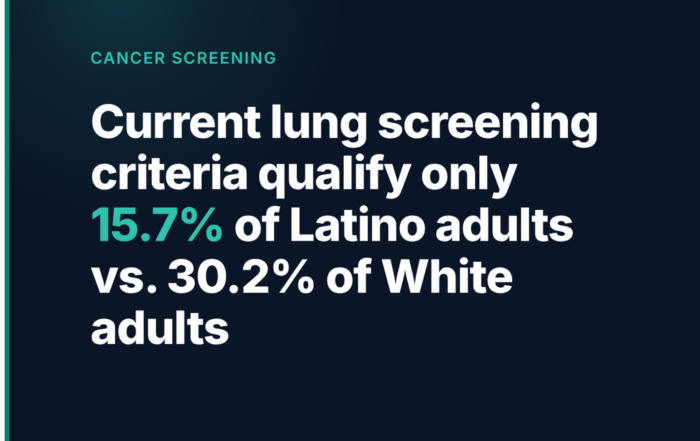
🔹 Latino participants: 15.7% eligible
After switching to a duration-based model using a threshold of more than 30 years, eligibility for African American participants rose to 30.4% and for Latino participants to 25.1%, according to the Annals of Internal Medicine Fresh Look Blog.
The detection gains are just as significant.
Sensitivity for lung cancer detection improved across every affected group after the switch. African American participants went from 44.0% to 60.9%. Latino participants went from 53.5% to 69.8%. Native Hawaiian participants saw a gain from 55.2% to 60.8%. Japanese American participants improved from 62.5% to 67.3%.
These are not small numbers. These are the patients most likely to be diagnosed late, most likely to die, and least likely to be sitting in a screening-eligible category under criteria designed around population averages.
⚠️ There is a real tradeoff here, and I want to name it directly. Expanding eligibility and boosting sensitivity means more lower-risk individuals enter screening pipelines, which can mean more false positives, more follow-up imaging, and more downstream cost and anxiety. Specificity dropped for African American participants from 79.2% to 70.3% and for Latino participants from 84.6% to 75.3%.
This is the honest tension in precision screening: broader nets catch more cancer and more noise.
But consider the alternative. A rulebook that leaves 15.7% of Latino adults eligible, versus 30.2% of White adults, is not a neutral policy choice. It encodes disparity into clinical infrastructure.
At Oatmeal Health, we see this every day. The communities we serve, the Federally Qualified Health Centers we partner with, are full of patients who have smoked for decades but never hit a pack-year threshold. Their risk is real. Their access to early detection is not.
The framework for thinking about duration-based versus pack-year-based criteria:
🔹 Who gains eligibility: Black and Latino adults see the largest increases
🔹 Where sensitivity improves: Detection gains of 7 to 17 percentage points across minority groups
🔹 Where the tradeoff lands: Specificity drops 9 to 11 points in the same populations
🔹 What this signals: Broadly applied screening frameworks do not perform uniformly across heterogeneous populations
Save this breakdown if you are working on screening equity, FQHC outreach protocols, or LDCT program design. The eligibility criteria you use today shapes who gets diagnosed tomorrow.
The question worth sitting with is not whether we can afford to update the criteria. It is whether we can afford to keep using ones that were never designed for the patients who need screening most.
👉 Follow Jonathan Govette, CEO of Oatmeal Health, for daily healthcare insights on LinkedIn. Deeper dives in The Oatmeal Bite on LinkedIn: https://www.linkedin.com/newsletters/the-oatmeal-bite-7368331304385314817/
Author:

CEO/Co-Founder @ Oatmeal Health | AI Lung Cancer Screening | Almost Became a Doctor | Engineer | Follow to Share What I’ve Learned Along the Way
I help patients get the care they need earlier, preventing late-stage cancer.
That’s been the throughline across three companies and almost 20 years in healthcare. At ReferralMD, we fixed broken referral networks so patients didn’t fall through the cracks. At Oatmeal Health, it’s lung cancer: building the diagnostic and screening infrastructure so the 85% of cases caught too late get caught early instead.
Today as CEO of Oatmeal Health, I lead a team embedding AI into radiology workflows to turn routine lung CT scans into reimbursable cancer risk assessments. We partner with FQHCs to reach underserved communities, and with health systems and payers to make early detection economically sustainable. Think HeartFlow or Cleerly, but for lungs.
Between companies, I advised at Techstars and Plug and Play, mentoring founders building in digital health. That experience shaped how I think about what separates companies that ship from companies that stall: distribution, reimbursement, and clinical trust, not just technology.
I’m a CancerX alumnus, a 3x healthcare founder, and someone who believes the biggest problems in cancer aren’t scientific. They’re operational.
We’re hiring mission-driven builders at Oatmeal Health. If you want to work on something that matters, reach out.
When I’m not working, I’m traveling, mentoring, and keeping up with one very energetic husky. 🐾
Substack – The Oatmeal Bite:
Millions of patients get less care because of who they are, where they live, or how they look. I’m fighting to change that. CEO @OatmealHealth, a startup built for the underserved. The Oatmeal Bite: intel for clinicians, investors, and advocates.
Jonathan Govette
CEO of Oatmeal Health
Substack:
https://oatmealhealthjonathangovette.substack.com/