This is the detailed version of MCED Blood Tests: The Screening Revolution.
The largest multi-cancer screening trial in history missed its primary goal. The FDA panel voted 7 to 2 to approve anyway. Here is what the evidence actually shows and what health systems need to plan for.
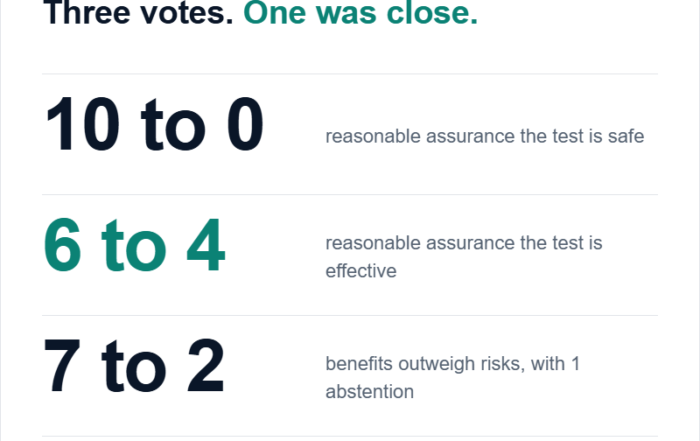
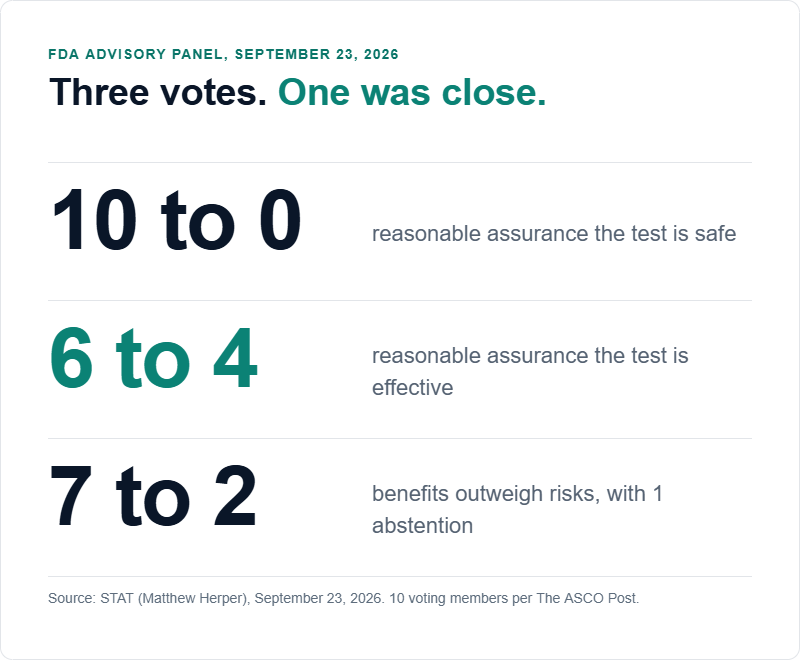
On September 23, 2026, an FDA advisory panel voted to recommend approval of GRAIL’s Galleri blood test for multi-cancer early detection. The vote that drew headlines was 7 to 2, with one abstention, that benefits outweigh risks. Two other votes happened the same day: 10 to 0 that the test is safe, and 6 to 4 that it is effective.
The 6-to-4 vote on effectiveness is the one that matters for every decision that follows: whether the FDA approves, whether coverage terms hold up to scrutiny, whether health system leaders should plan for this test in their 2027 budgets, and whether a clinic serving a low-income or rural population should treat Galleri as a tool or a distraction.
This article is not a recommendation for or against Galleri. It is an attempt to lay out what the trials actually showed, where the data are incomplete, what Medicare coverage means in practice, and what lung screening has to do with all of it.
1. The Panel Vote: What Three Numbers Actually Mean
The Molecular and Clinical Genetics Devices Panel has ten voting members. On September 23, the panel faced three questions. STAT reported the results: ten to zero that the test provides reasonable assurance of safety, six to four that it provides reasonable assurance of effectiveness, and seven to two with one abstention that the benefits outweigh risks for patients who meet the proposed indication.
An advisory committee vote does not bind the FDA. The agency frequently follows panel recommendations, but it is not required to. Neither the FDA nor GRAIL has published a decision date. Longevity Benchmark reported on September 27 that the test remains unapproved and a decision is expected “in the coming months.” Nothing about insurance coverage, reimbursement rates, or clinic workflow is settled until the FDA acts.
The test itself is a qualitative next-generation sequencing assay that reads cancer-specific methylation patterns in cell-free DNA from a blood draw. The ASCO Post described it as prescription-only, intended for adults 50 and older, capable of flagging where a detected signal may have originated, and requiring a diagnostic workup after every positive result. The FDA designated Galleri a Breakthrough Device in 2018. GRAIL filed its premarket approval application on January 29, 2026.
The six-to-four split on effectiveness is not a fluke or a close call on a minor point. According to Longevity Benchmark and Endpoints News, the split centered on the NHS-Galleri trial, the largest prospective randomized study of any cancer screening test ever conducted. That trial enrolled 142,250 people. It also missed its primary endpoint.
Four panelists voted that the test does not meet reasonable assurance of effectiveness. That is a substantial minority on a ten-person panel. The 7-to-2 benefits vote carried the day, but the panel members who voted yes on benefits include the same question: they were voting on whether a test with an uncertain effectiveness record still does more good than harm. That is a harder bar than “effectiveness is proven.”
2. NHS-Galleri: The Trial That Screened 142,250 People
The NHS-Galleri trial is the anchor of this decision. It enrolled 142,250 people aged 50 to 77 across England and screened them annually for up to three rounds. GRAIL released full results on May 30, 2026.
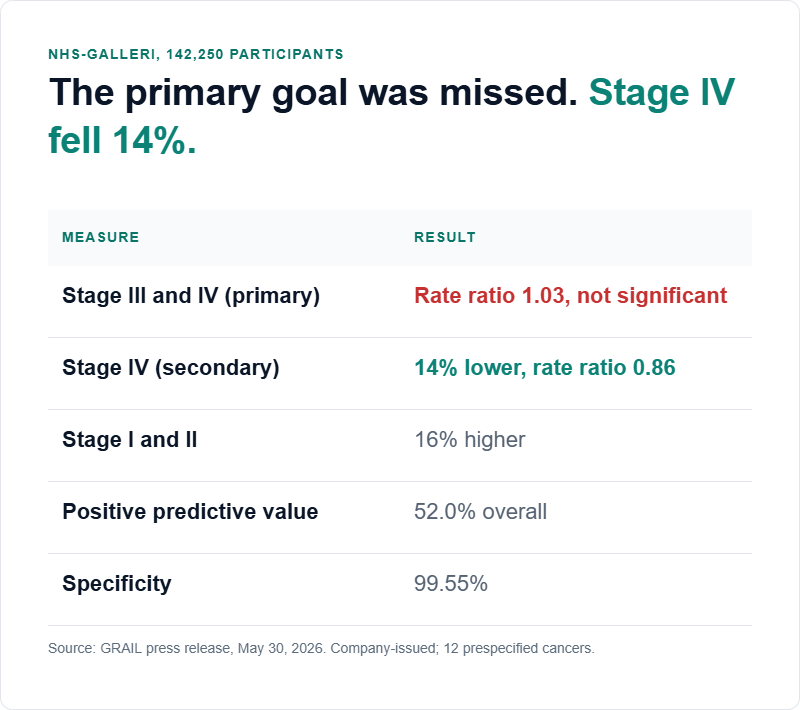
The primary endpoint was the combined incidence of stage III and IV diagnoses across twelve prespecified cancer types. GRAIL’s press release reports an incidence rate ratio of 1.03, with a 95% confidence interval of 0.92 to 1.14 and a p-value of 0.6324. A rate ratio above 1.0 means the screened group had slightly more late-stage diagnoses. The result was not statistically significant. The trial, as designed, did not show that Galleri reduces late-stage cancer diagnoses.
The secondary results are different. Stage IV diagnoses across the twelve cancers were 14% lower in the screened group, with a rate ratio of 0.86 and an interval of 0.744 to 0.998. GRAIL describes that as nominally statistically significant. By screening round, the stage IV reduction was 9% in the first round, 22% in the second, and 26% in the third. Stage I and II diagnoses rose 16%. Positive predictive value was 52.0% overall and 58.0% in round one. Specificity was 99.55%.
Two things matter here. First, the GRAIL press release is a company document. At the time of release, the results had not been peer reviewed, though The ASCO Post subsequently reported both major trials have since been published. This article used the press release for NHS-Galleri data and has not checked the published papers. Discrepancies may exist.
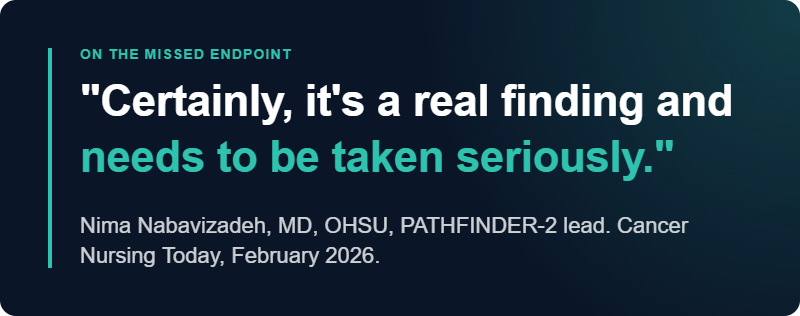
Second, a secondary endpoint with a confidence interval that ends at 0.998 is a finding worth investigating, not a settled clinical benefit. Nima Nabavizadeh, MD, of OHSU, who leads the PATHFINDER 2 trial, told Cancer Nursing Today in February 2026 that combining stage III and IV was “certainly an ambitious goal” and that the stage IV finding “needs to be taken seriously.” Elizabeth O’Donnell, MD, of Dana-Farber, said of the press release: “What the press release offers is very limited.”
The core question the FDA and future health system planners are weighing: can a test that missed its designed endpoint on the combined primary measure, but showed a real secondary signal on stage IV diagnoses, be called effective for clinical purposes? The panel was split. That split is the starting point for every downstream decision.
3. PATHFINDER 2: What the Seven-Fold Number Means and Does Not
PATHFINDER 2 is the other major pillar. GRAIL’s October 17, 2025 press release describes a trial with 35,878 enrolled participants, of whom 25,578 had at least twelve months of follow-up, and 23,161 were analyzable for performance.
Key performance figures: a cancer signal detection rate of 0.93%, a confirmed cancer detection rate of 0.57%, a positive predictive value of 61.6%, and specificity of 99.6%. Of the cancers PATHFINDER 2 detected, 53.5% were stage I or II. GRAIL reports approximately three-quarters of those cancers had no standard-of-care screening available. Episode sensitivity was 40.4% for all cancers and 73.7% for the twelve cancers GRAIL says cause two-thirds of US cancer deaths.
The headline claim is a “more than seven-fold increase” in cancers found within one year when Galleri is added to the USPSTF A and B recommended screenings for breast, cervical, colorectal, and lung cancer. Cancer Nursing Today made the critical point clearly: PATHFINDER 2 is a single-arm study with no comparison group. That means it cannot answer the question NHS-Galleri was built to answer: does finding more cancer lead to fewer deaths?
Seven-fold is a comparison to standard screenings. It means Galleri found more cancer in a year. Finding more cancer is only beneficial if the cancers found are ones that would have caused harm, and if earlier treatment actually improves outcomes for those cancer types. Some cancers grow slowly enough that earlier detection changes nothing except the length of time a patient carries a diagnosis. Others are so aggressive that even stage I detection is too late. The seven-fold number does not tell us which of those situations applies to the extra cancers Galleri found.
This is not an argument against the test. It is a description of what a single-arm trial can and cannot prove. Randomized evidence, which NHS-Galleri was designed to provide, is still the gold standard for demonstrating that screening saves lives. The NHS-Galleri data on stage IV diagnoses are the closest thing to that evidence. They are suggestive. They are not conclusive.
Public Citizen, which opposes Galleri’s approval, submitted written testimony by Nina Zeldes, PhD, on September 23. It argues that sensitivity for stage I and II combined ranged from only 21% to 25%, and that across both trials sensitivity by cancer type ranged from 1.6% for some skin cancers to 81% for liver and bile duct cancers. GRAIL’s 40.4% figure covers all stages. Both can be accurate at the same time, because they measure different things. The test catches some cancers reliably and others rarely.
4. Who Was in the Trials
For a health center serving low-income or underserved communities, trial demographics are not a footnote. They determine whether the published performance figures are likely to hold in the patients a clinic actually sees.
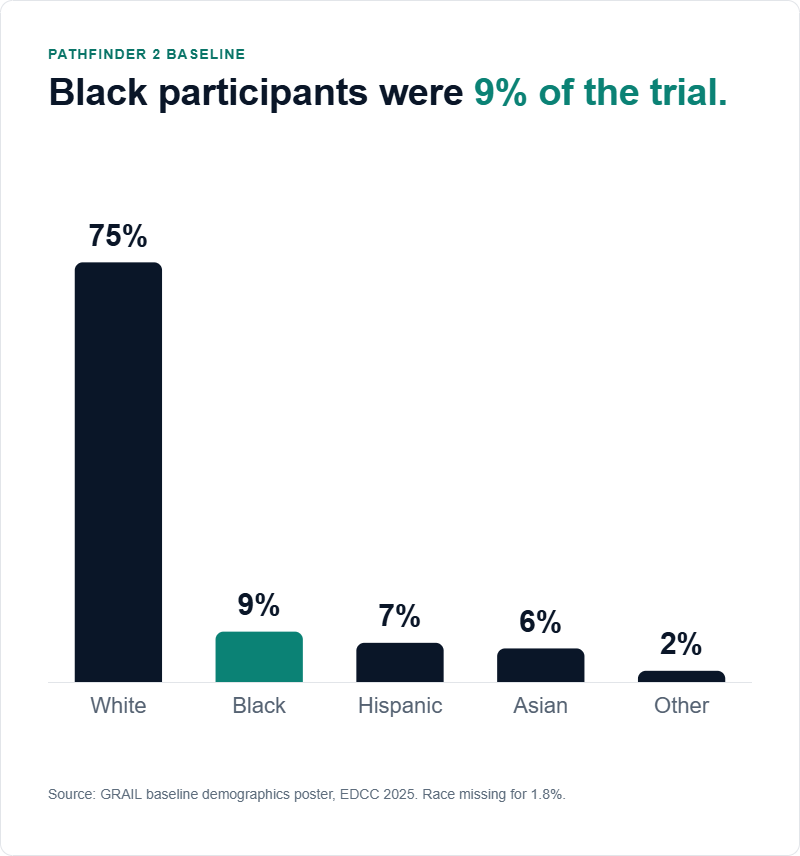
GRAIL’s baseline demographics poster for PATHFINDER 2, presented by Gadgeel at EDCC 2025, reports enrollment at 75% non-Hispanic White, 9% non-Hispanic Black, 7% Hispanic, 6% non-Hispanic Asian, and 2% other, with race or ethnicity missing for 1.8% of participants. Median age was 64. The poster notes that participants were more highly educated than a national reference population, and it does not report income.
Public Citizen’s testimony gives different figures: 81% White in PATHFINDER 2 and 94% White in NHS-Galleri. The difference probably reflects different grouping methods, and this article has not reconciled the counts. What is consistent across both sources is that both trials enrolled populations that were predominantly White, more educated, and at a higher income level than the populations most likely to benefit from new screening access.
GRAIL has attempted to address this. Its 2026 poster, presented at EDCC 2026, reports a health equity subgroup analysis finding performance “broadly consistent across racial and ethnic groups,” with specificity of at least 99.3% and positive predictive value of at least 40% in every racial and ethnic subgroup. The analysis included 2,754 Black participants and 440 American Indian or Alaska Native participants out of 32,007 total.
The authors note the limitations themselves: analyses are descriptive, smaller subgroups had wide confidence intervals and few positive results, and comparisons across groups should be interpreted carefully. The study was GRAIL-funded, and several authors are employees or consultants of the company. The health equity data are a start, not a resolution. A Black patient at a federally qualified health center asking whether the test works for her will not find a definitive answer in these numbers.
5. False Positives and What Happens After the Blood Draw
Specificity of 99.6% sounds like near-perfection. For a cancer screening test, it is genuinely good performance. But the math has consequences at scale.
A specificity of 99.6% means about four people per thousand screened will receive a false positive result. A positive predictive value of 61.6%, from PATHFINDER 2, means that about 38.4% of positive signals are not confirmed cancer. In NHS-Galleri, with a PPV of 52.0%, nearly half of positive signals were not confirmed cancer. These figures come from GRAIL’s own data. The arithmetic (38.4% unconfirmed in PATHFINDER 2, about four per thousand false positives) is ours, derived from the published rates.
The ASCO Post notes that every positive signal requires a diagnostic workup, which may involve imaging, specialist visits, additional blood work, and sometimes a biopsy. Public Citizen’s Zeldes testimony describes the risk of “a cascade of unnecessary diagnostic tests and invasive procedures,” along with longer wait times, time away from work, and out-of-pocket costs. MedPath Trial, aggregating coverage from The Globe and Mail and The Motley Fool, notes that false positives create follow-up testing costs that fall on payers.
What no source we read addressed directly: who pays for the workup after a positive result? The Medicare coverage law pays for the screening test. It does not, as far as the sources we found describe it, specify coverage for follow-up imaging or specialist visits triggered by a positive MCED result. For a commercially insured patient with a primary care relationship, follow-up from an unexpected cancer signal is a disruption. For an uninsured patient at a health center, it can end the pathway entirely.
This is the same problem that has confronted every mass screening program. The test is not the hard part. The hard part is what happens after a positive result for patients who lack transportation, have no PCP, cannot take time off work, or face a cost-sharing structure that makes the next appointment unaffordable. Health systems planning for MCED adoption need a protocol for every positive result, not just the ones that reach a specialist visit.
6. Medicare, Pricing, Competing Tests, and What to Do Before the FDA Decides
The Nancy Gardner Sewell Medicare Multi-Cancer Early Detection Screening Coverage Act, H.R. 842, was signed on February 3, 2026. The Prevent Cancer Foundation and the office of Rep. Mariannette Miller-Meeks confirm the signing date. Rep. Terri Sewell’s office says the bill attracted 339 House and 68 Senate cosponsors and that 70% of cancer deaths involve cancers with no established screening test.
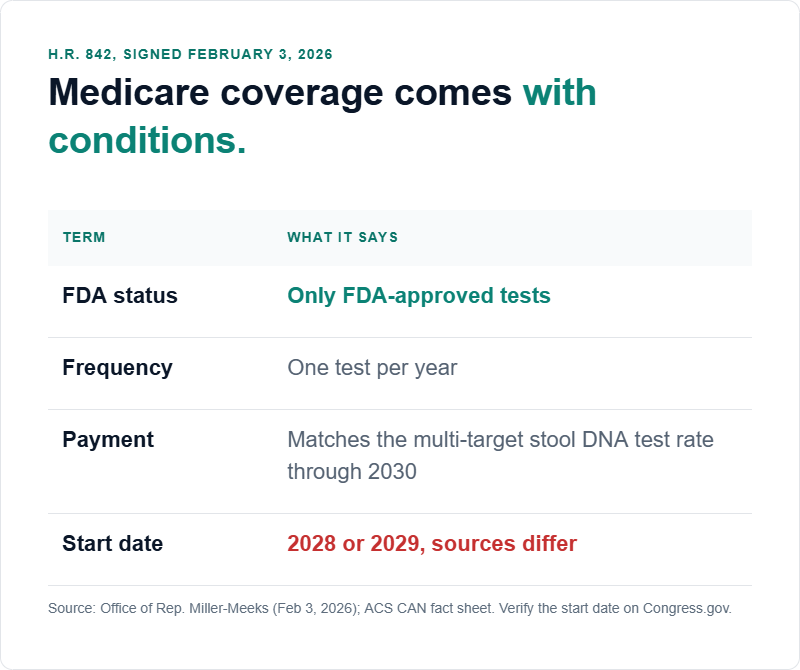
Key coverage terms from Miller-Meeks’s office: coverage applies only to MCED tests with FDA approval, one test per year per beneficiary, payment benchmarked to the multi-target stool DNA test rate through 2030, with CMS authority to adjust using the clinical laboratory payment system from 2031.
The start date is unsettled. Miller-Meeks’s office states coverage begins in 2028. An ACS CAN fact sheet on the act says tests furnished on or after January 1, 2029. That document appears to mix bill versions, and its table is difficult to reconcile. The difference between 2028 and 2029 matters for budget planning and vendor negotiations. The safest approach is to read the enacted text in H.R. 842 on Congress.gov rather than relying on any secondary summary, including this one.
Pricing is the second open variable. MedPath Trial, aggregating reporting from The Globe and Mail and The Motley Fool, reports that Galleri carries a list price of $949. Exact Sciences launched a competing multi-cancer blood test called Cancerguard on September 11, 2025, at a list price of $689. Fierce Biotech, in coverage by Conor Hale, describes Cancerguard as a laboratory-developed test covering more than fifty cancer types excluding breast and prostate, with company-reported sensitivity of 68% across six named cancers including lung, and 64% overall excluding breast and prostate. Fierce did not describe any FDA review at launch.
These are not comparable performance figures. Galleri and Cancerguard used different study designs, enrolled different populations, and measured sensitivity differently. What the price gap shows is that a market is forming before the FDA has finished its first review, and that a $260 difference between tests will matter in any self-pay or sliding-scale program.
For health system leaders and FQHC directors, the preparation work is available now, before any FDA decision. Four questions define whether your organization will be positioned to use MCED well or will be caught unprepared. First, how do you identify eligible patients proactively rather than waiting for them to ask? The patients most likely to benefit from new screening access are often the ones least likely to initiate it. Second, are your referral pathways designed for patients without a primary care relationship? A positive blood test with no established provider is a result with nowhere to go. Third, what is your protocol when a test flags something and the patient goes silent? Fourth, who pays for the follow-up imaging?
Ask vendors for data you need but have not been given: results for patients with income levels like yours, the published NHS-Galleri paper rather than the press release, and a plain statement of which payors will cover the diagnostic workup after a positive signal. Budget the workup before you budget the test. At a 38% unconfirmed rate, a positive signal from Galleri will generate imaging and specialist time even when it leads to good news.
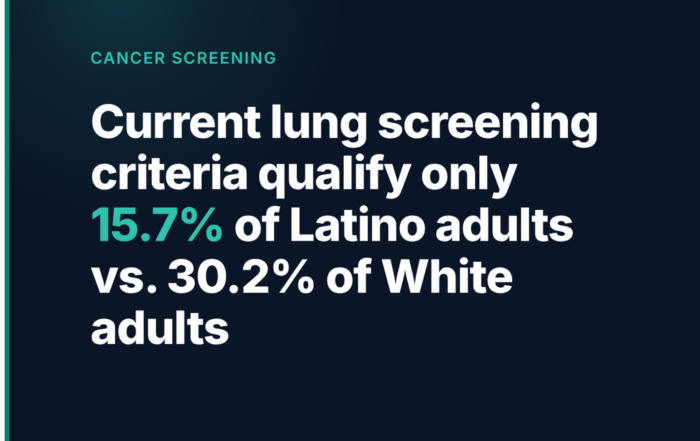
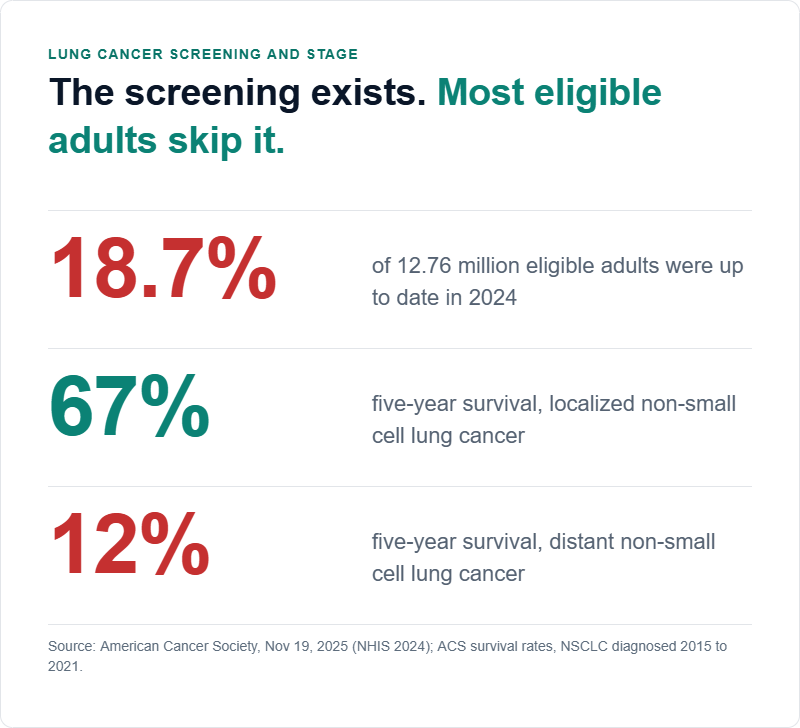
Oatmeal Health works in the lung cancer screening lane: finding high-risk, unscreened patients and navigating them to low-dose CT. Lung cancer already has a screening test, and only about 18.7% of eligible adults are up to date, according to ACS data from November 2025 based on the National Health Interview Survey. Five-year relative survival for non-small cell lung cancer is 67% when localized, 40% when regional, and 12% when distant. Closing that gap with an existing tool remains the most evidence-based move available today. Kevin Oeffinger, MD, of the Duke Cancer Institute, said it plainly in a Duke article from September 2026: “Patients should continue to receive all age- and risk-appropriate screenings.” An MCED blood test, if approved and covered, should add to that screening, not replace it.
Jonathan Govette is Co-Founder and CEO of Oatmeal Health, an AI lung cancer diagnostics company helping catch cancers earlier in underserved communities.
Key References
STAT, Matthew Herper, September 23, 2026: FDA advisory panel endorses GRAIL’s Galleri multi-cancer blood test. Source for 10-0, 6-4, and 7-2 votes and the 10-member panel.
The ASCO Post staff, September 2026: FDA Advisory Committee Votes in Favor of Approval of Multi-Cancer Early Detection Test. Source for test description, proposed indication, 2018 Breakthrough Device designation, and workup requirement.
Endpoints News, September 2026: FDA adcomm raises questions on effectiveness of GRAIL’s cancer test. Source for framing of effectiveness split.
Longevity Benchmark, Jonathan West, September 27, 2026: Source for January 29, 2026 PMA submission date, lack of published decision date, and reading of the effectiveness split as centered on NHS-Galleri.
GRAIL press release, May 30, 2026: GRAIL Reports Full Results from NHS-Galleri Trial. Company document, not peer-reviewed at release. Source for all NHS-Galleri trial figures: IRR 1.03 (p=0.6324), stage IV RR 0.86 (0.744-0.998), round-by-round reduction (9%/22%/26%), stage I-II +16%, PPV 52.0% (58.0% round 1), specificity 99.55%.
GRAIL press release, October 17, 2025: PATHFINDER 2 results. Company document. Source for enrollment figures, CDR 0.57%, CSDR 0.93%, PPV 61.6%, specificity 99.6%, sensitivity 40.4%/73.7%, 53.5% stage I-II, three-quarters with no standard screening, seven-fold add-on claim.
GRAIL / Gadgeel, EDCC 2025 poster: PATHFINDER 2 baseline demographics. Source for 75% NH White, 9% NH Black, 7% Hispanic, 6% NH Asian, median age 64, education note, missing income.
GRAIL / Demeure, EDCC 2026 poster: Health equity subgroup analysis. Source for “broadly consistent” finding, specificity >=99.3%, PPV >=40%, 2,754 Black and 440 AIAN participants out of 32,007.
Cancer Nursing Today, Melissa Badamo, February 25, 2026: Source for Nabavizadeh and O’Donnell quotes and single-arm PATHFINDER 2 limitation.
Public Citizen, written testimony by Nina Zeldes PhD, September 23, 2026: Source for 21-25% stage I-II sensitivity range, 1.6%-81% by cancer type, 94% White in NHS-Galleri, 81% White in PATHFINDER 2, false-positive cascade description. Public Citizen opposes approval.
Office of Rep. Mariannette Miller-Meeks, February 2026: Source for H.R. 842 signing date (February 3, 2026), coverage starting in 2028, FDA approval requirement, annual coverage, and stool DNA rate benchmark.
Office of Rep. Terri Sewell, February 4, 2026: Source for 70% of cancer deaths figure and 339 House/68 Senate cosponsors.
ACS CAN MCED Act fact sheet: Source for January 1, 2029 start date (conflict noted; document appears to mix bill versions).
Prevent Cancer Foundation: Source for signing date and FDA approval requirement.
MedPath Trial, October 11, 2026 (aggregating Globe and Mail/Motley Fool): Source for $949 list price. Labeled as aggregated from other outlets.
Fierce Biotech, Conor Hale: Source for Cancerguard $689 price, September 11, 2025 launch, 50+ cancer types, company-reported sensitivities.
American Cancer Society press release, November 19, 2025, and JAMA with Priti Bandi: Source for 18.7% lung screening uptake among 12.76 million eligible adults and 82.4% NH White share.
ACS survival rates page: Source for 67%/40%/12% five-year NSCLC survival by stage (2015-2021 data).
Duke Cancer Institute, Carolyn Dean, September 10, 2026: Source for Oeffinger quote.
Our arithmetic: 38.4% unconfirmed (100 minus PPV 61.6%), approximately 4 per 1,000 false positives (0.4% from 99.6% specificity), $260 price gap between Galleri and Cancerguard.
Author:

CEO/Co-Founder @ Oatmeal Health | AI Lung Cancer Screening | Almost Became a Doctor | Engineer | Follow to Share What I’ve Learned Along the Way
I help patients get the care they need earlier, preventing late-stage cancer.
That’s been the throughline across three companies and almost 20 years in healthcare. At ReferralMD, we fixed broken referral networks so patients didn’t fall through the cracks. At Oatmeal Health, it’s lung cancer: building the diagnostic and screening infrastructure so the 85% of cases caught too late get caught early instead.
Today as CEO of Oatmeal Health, I lead a team embedding AI into radiology workflows to turn routine lung CT scans into reimbursable cancer risk assessments. We partner with FQHCs to reach underserved communities, and with health systems and payers to make early detection economically sustainable. Think HeartFlow or Cleerly, but for lungs.
Between companies, I advised at Techstars and Plug and Play, mentoring founders building in digital health. That experience shaped how I think about what separates companies that ship from companies that stall: distribution, reimbursement, and clinical trust, not just technology.
I’m a CancerX alumnus, a 3x healthcare founder, and someone who believes the biggest problems in cancer aren’t scientific. They’re operational.
We’re hiring mission-driven builders at Oatmeal Health. If you want to work on something that matters, reach out.
When I’m not working, I’m traveling, mentoring, and keeping up with one very energetic husky. 🐾
Substack – The Oatmeal Bite:
Millions of patients get less care because of who they are, where they live, or how they look. I’m fighting to change that. CEO @OatmealHealth, a startup built for the underserved. The Oatmeal Bite: intel for clinicians, investors, and advocates.
Jonathan Govette
CEO of Oatmeal Health
Substack:
https://oatmealhealthjonathangovette.substack.com/