What does your doctor do while waiting on a prior auth fax?
They wait. Your patient waits. And care gets delayed for no clinical reason.
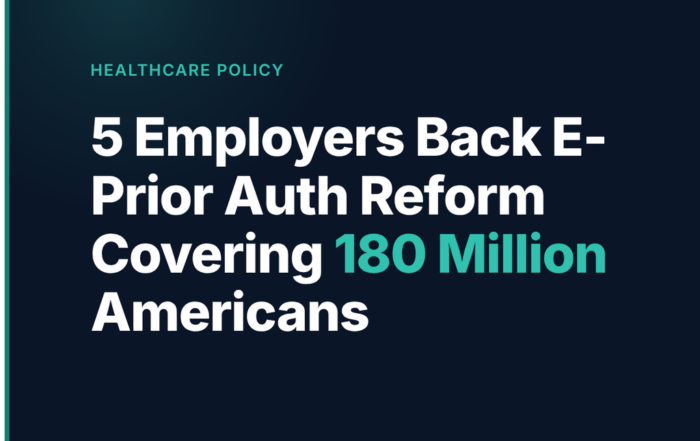
This week, CMS and the Department of Labor announced that five major employers signed a statement of support to expand electronic prior authorization to self-funded health plans. According to U.S. Census data cited in the announcement, more than 53% of Americans, over 180 million people, receive their health coverage through employers that sponsor self-funded health plans.
The employers who signed on:
🔹 Amazon
🔹 Google
🔹 Meta
🔹 Axon Enterprise
🔹 Oracle Corporation
These are not small players dabbling in benefits policy. These are companies whose combined workforce touches hundreds of thousands of Americans.
💡 So what actually changes?
CMS’ Interoperability and Prior Authorization Final Rule already requires certain impacted payers to implement electronic prior authorization capabilities for medical items and services beginning January 1, 2027. This employer commitment extends the momentum of that mandate into the self-funded commercial market, where federal rules have historically had less direct reach.
A fragmented prior authorization system forces healthcare providers to navigate different workflows depending on a patient’s coverage. That sentence, pulled directly from the CMS announcement, should be read aloud in every hospital boardroom in America.
The administration is also building demand, not just supply. By bringing employers to the table alongside insurers, providers, and technology companies, the strategy signals that electronic prior auth reform will not live and die in the regulatory world alone.
But I’ll be direct about what this is not yet.
A statement of support is not a contract. Five employers is a start, not a system. And the January 1, 2027 deadline applies to certain impacted payers, not to the entire self-funded market.
The structural problem is real. Providers today navigate completely different workflows depending on whether a patient is in a fully-insured plan, a self-funded plan, or a government program. Electronic prior auth solves a slice of that. It does not solve the underlying incentive for payers to use prior auth as a utilization brake in the first place.
What I do believe: employer pressure, sustained and organized, will do more to accelerate this than any single rule. When Amazon and Google tell their third-party administrators to modernize, those administrators move.
Whether 175 million other plan members ever see that same urgency from their employer is still the open question.
👉 Follow Jonathan Govette, CEO of Oatmeal Health, for daily healthcare insights on LinkedIn. Deeper dives in The Oatmeal Bite on LinkedIn: https://www.linkedin.com/newsletters/the-oatmeal-bite-7368331304385314817/
Author:
CEO/Co-Founder @ Oatmeal Health | AI Lung Cancer Screening | Almost Became a Doctor | Engineer | Follow to Share What I’ve Learned Along the Way
I help patients get the care they need earlier, preventing late-stage cancer.
That’s been the throughline across three companies and almost 20 years in healthcare. At ReferralMD, we fixed broken referral networks so patients didn’t fall through the cracks. At Oatmeal Health, it’s lung cancer: building the diagnostic and screening infrastructure so the 85% of cases caught too late get caught early instead.
Today as CEO of Oatmeal Health, I lead a team embedding AI into radiology workflows to turn routine lung CT scans into reimbursable cancer risk assessments. We partner with FQHCs to reach underserved communities, and with health systems and payers to make early detection economically sustainable. Think HeartFlow or Cleerly, but for lungs.
Between companies, I advised at Techstars and Plug and Play, mentoring founders building in digital health. That experience shaped how I think about what separates companies that ship from companies that stall: distribution, reimbursement, and clinical trust, not just technology.
I’m a CancerX alumnus, a 3x healthcare founder, and someone who believes the biggest problems in cancer aren’t scientific. They’re operational.
We’re hiring mission-driven builders at Oatmeal Health. If you want to work on something that matters, reach out.
When I’m not working, I’m traveling, mentoring, and keeping up with one very energetic husky. 🐾
Substack – The Oatmeal Bite:
Millions of patients get less care because of who they are, where they live, or how they look. I’m fighting to change that. CEO @OatmealHealth, a startup built for the underserved. The Oatmeal Bite: intel for clinicians, investors, and advocates.
Jonathan Govette
CEO of Oatmeal Health
Substack:
https://oatmealhealthjonathangovette.substack.com/