Share this article and save a life!
🚨 FQHC CEO, is your revenue model built for what just happened?
Nearly 450,000 New Yorkers just lost their health coverage. On July 1. Not a projection. Done.
📰 According to Time, those New Yorkers were enrolled in New York’s Essential Plan, a taxpayer-subsidized program established in 2015 under the Affordable Care Act. It had covered more than a million New Yorkers at extremely low cost. The coverage loss was triggered by HR 1, the “Big Beautiful Bill,” signed into law on July 4, 2025. The federal government withdrew the funding that allowed New York to use ACA tax credits for certain legally present immigrants. The state changed eligibility. Hundreds of thousands lost their plans overnight.
🔍 Here is what most people are missing. This is not a New York story. It is a preview. The Congressional Budget Office estimated that Medicaid changes under HR 1 would result in 7.8 million more people in the U.S. without health insurance by 2034. The Urban Institute projected the number could be higher and faster, up to 10.1 million fewer people enrolled in Medicaid by 2028. Starting January 1, 2027, adults in expanded Medicaid states must meet an 80 hours per month work requirement. States must now verify eligibility every six months instead of annually. These are not distant policy debates. They are operational realities for every FQHC in the country.
📊 The enrollment data is already moving. The federal government released data on June 26, 2026, showing that 19.2 million people enrolled in ACA Exchange plans in 2026. That is down about three million from the 22.1 million who enrolled in 2025. People are not migrating to other coverage. They are going uninsured. And Time notes that federally qualified health centers are already struggling because many of their patients are on Medicaid, and Medicaid often compensates them at a lower rate.
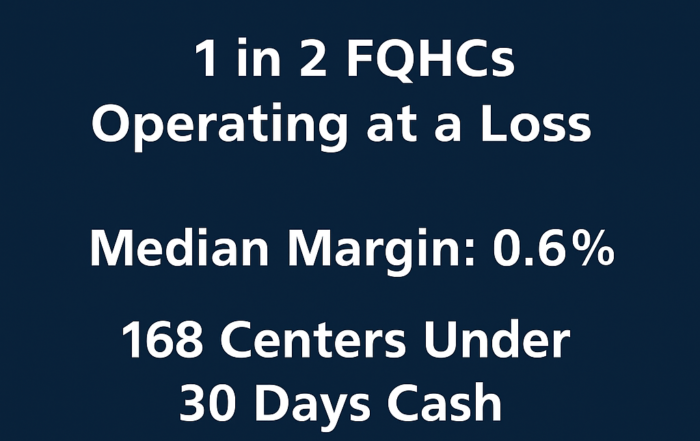
⚡ This is the pressure every FQHC CFO and CEO needs to plan around right now. More uninsured patients means more uncompensated visits. Less Medicaid revenue per visit means tighter margins on every encounter you already have. The patients do not stop coming. That is the whole point of the safety net. But the economics of absorbing this wave without a plan will break organizations that are not ready.
💡 The FQHCs that survive this period will be the ones that proactively close the gap between what they can bill and what they are actually capturing. Every undocumented eligible visit, every missed preventive service, every screening that was delivered but not coded, those are the dollars that keep the lights on when payer mix craters. The margin is already thin. It is about to get thinner.
🔥 The uninsured wave is not a future risk for FQHCs. It landed on July 1.
❓ FQHC CFOs and CEOs, what concrete steps has your organization taken this quarter to protect revenue as your payer mix shifts? Be specific. The community needs real answers, not talking points.
👉 Follow Jonathan Govette, CEO of Oatmeal Health, for daily healthcare insights on LinkedIn. Deeper dives in The Oatmeal Bite on Substack: https://oatmealhealthjonathangovette.substack.com
Share this article and save a life!
Author:
CEO/Co-Founder @ Oatmeal Health | AI Lung Cancer Screening | Almost Became a Doctor | Engineer | Follow to Share What I’ve Learned Along the Way
I help patients get the care they need earlier, preventing late-stage cancer.
That’s been the throughline across three companies and almost 20 years in healthcare. At ReferralMD, we fixed broken referral networks so patients didn’t fall through the cracks. At Oatmeal Health, it’s lung cancer: building the diagnostic and screening infrastructure so the 85% of cases caught too late get caught early instead.
Today as CEO of Oatmeal Health, I lead a team embedding AI into radiology workflows to turn routine lung CT scans into reimbursable cancer risk assessments. We partner with FQHCs to reach underserved communities, and with health systems and payers to make early detection economically sustainable. Think HeartFlow or Cleerly, but for lungs.
Between companies, I advised at Techstars and Plug and Play, mentoring founders building in digital health. That experience shaped how I think about what separates companies that ship from companies that stall: distribution, reimbursement, and clinical trust, not just technology.
I’m a CancerX alumnus, a 3x healthcare founder, and someone who believes the biggest problems in cancer aren’t scientific. They’re operational.
We’re hiring mission-driven builders at Oatmeal Health. If you want to work on something that matters, reach out.
When I’m not working, I’m traveling, mentoring, and keeping up with one very energetic husky. 🐾
Substack – The Oatmeal Bite:
Millions of patients get less care because of who they are, where they live, or how they look. I’m fighting to change that. CEO @OatmealHealth, a startup built for the underserved. The Oatmeal Bite: intel for clinicians, investors, and advocates.
Jonathan Govette
CEO of Oatmeal Health
Substack:
https://oatmealhealthjonathangovette.substack.com/