Share this article and save a life!
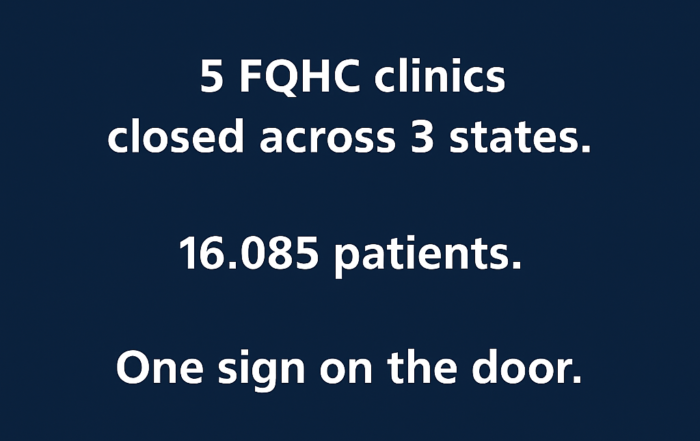
32+ million patients. One budget line. One vote away from a crisis.
Federally Qualified Health Centers are the backbone of primary care for America’s most vulnerable populations. Rural families. Uninsured workers. Medicaid enrollees. Immigrants. People who have nowhere else to go.
And right now, that backbone is under serious financial pressure.
The Community Health Center Fund, authorized under Section 330 of the Public Health Service Act, provides roughly $4 billion annually to over 1,400 FQHCs across the country. It covers nearly one-third of the total operating budgets at many sites. Without it, a clinic doesn’t just struggle. It closes.
As Congress pushes through budget reconciliation in May 2026, the Community Health Center Fund is caught in the crossfire. Proposed spending offsets in the reconciliation package could result in flat funding or outright reductions for the next five-year authorization cycle, which is up for renewal this year.
Here is what makes this particularly dangerous:
FQHCs operate on razor-thin margins. The average FQHC generates about $0.03 of operating margin per dollar of revenue. Any meaningful cut to Section 330 dollars does not get absorbed by reserves. It gets absorbed by staff reductions, service line eliminations, or site closures.
In states with the highest uninsured rates, such as Texas, Florida, and Mississippi, FQHCs are often the only primary care option in entire counties. A 10 percent funding reduction in those markets is not a budget problem. It is a public health emergency.
And this is happening at the same time Medicaid enrollment is projected to drop due to eligibility redeterminations and proposed work requirements. The patients being pushed off Medicaid rolls do not disappear. They show up at the FQHC front desk.
So the math is brutal: more patients, fewer federal dollars.
What should FQHC leaders be doing right now?
First, model your scenarios. If Section 330 funding drops 10, 20, or 30 percent, what does your operating budget look like? Build those models before you need them.
Second, diversify revenue aggressively. Value-based contracts, 340B optimization, and telehealth billing are not optional strategies anymore. They are survival strategies.
Third, tell your story loudly. Policymakers respond to real data from real communities. Your patient volume numbers, your cost-per-visit benchmarks, and your uncompensated care totals are not internal metrics. They are advocacy tools.
The FQHC model works. It delivers primary care at roughly 24 percent lower cost than private practices and reduces unnecessary emergency department visits. The ROI on Section 330 funding is not a question. The political will to protect it is.
💬 If Section 330 funding is cut and FQHC sites begin closing, who absorbs those 32 million patients? The emergency department? The urgent care that does not accept Medicaid? I want to hear how FQHC leaders are thinking about contingency planning right now.
♻️ Repost if every American deserves a primary care home, regardless of zip code or insurance status.
👉 Follow me for daily, real-time updates on healthcare technology and business news.
Share this article and save a life!
Author:
CEO/Co-Founder @ Oatmeal Health | AI Lung Cancer Screening | Almost Became a Doctor | Engineer | Follow to Share What I’ve Learned Along the Way
I help patients get the care they need earlier, preventing late-stage cancer.
That’s been the throughline across three companies and almost 20 years in healthcare. At ReferralMD, we fixed broken referral networks so patients didn’t fall through the cracks. At Oatmeal Health, it’s lung cancer: building the diagnostic and screening infrastructure so the 85% of cases caught too late get caught early instead.
Today as CEO of Oatmeal Health, I lead a team embedding AI into radiology workflows to turn routine lung CT scans into reimbursable cancer risk assessments. We partner with FQHCs to reach underserved communities, and with health systems and payers to make early detection economically sustainable. Think HeartFlow or Cleerly, but for lungs.
Between companies, I advised at Techstars and Plug and Play, mentoring founders building in digital health. That experience shaped how I think about what separates companies that ship from companies that stall: distribution, reimbursement, and clinical trust, not just technology.
I’m a CancerX alumnus, a 3x healthcare founder, and someone who believes the biggest problems in cancer aren’t scientific. They’re operational.
We’re hiring mission-driven builders at Oatmeal Health. If you want to work on something that matters, reach out.
When I’m not working, I’m traveling, mentoring, and keeping up with one very energetic husky. 🐾
Substack – The Oatmeal Bite:
Millions of patients get less care because of who they are, where they live, or how they look. I’m fighting to change that. CEO @OatmealHealth, a startup built for the underserved. The Oatmeal Bite: intel for clinicians, investors, and advocates.
Jonathan Govette
CEO of Oatmeal Health
Substack:
https://oatmealhealthjonathangovette.substack.com/