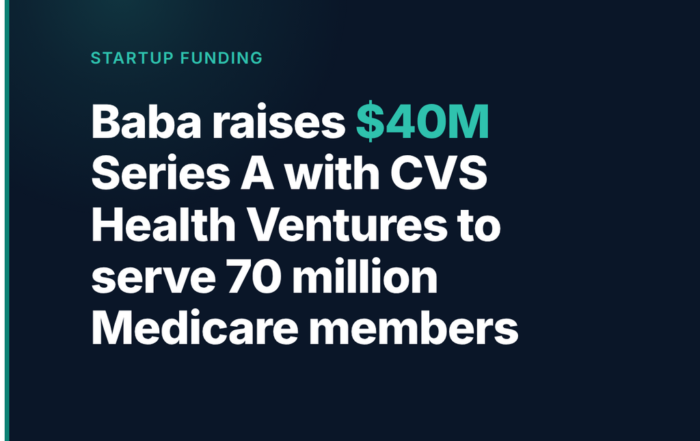
Everyone said AI would replace care coordinators. Baba raised $40M to hire more of them. 🏥
That contrast is exactly what makes this round worth paying attention to.
Baba, the New York-based applied AI company, closed a $40 million Series A this week led by FirstMark Capital. CVS Health Ventures and Valtruis joined the round alongside returning investors General Catalyst, Genius Ventures, and Ground Up Ventures.
The pitch is not automation in the traditional sense. Baba gives each Medicare and Medicaid member a dedicated team of care advocates and licensed therapists, backed by AI that connects medical, financial, social, and behavioral health needs into one workflow. The human stays in the loop. The AI makes that human faster, more informed, and more effective.
According to RuntimeWire, Baba says it has served fewer than 1% of Medicare’s roughly 70 million members. That number is not a warning. It is the entire market thesis.
🔹 $40M Series A led by FirstMark Capital
🔹 CVS Health Ventures and Valtruis as new participants
🔹 General Catalyst returning alongside Genius Ventures and Ground Up Ventures
🔹 Funds go toward expanding clinical care teams, AI research, and health plan partnerships
🔹 Value-based care arrangements are the stated commercial priority
The CVS Health Ventures participation is the signal I keep coming back to.
When a major payer’s venture arm writes a check into a care navigation company at Series A, they are not making a financial bet. They are making a strategic one. CVS wants to understand whether human-plus-AI advocacy can reduce downstream utilization costs for their Medicare plan members. That is the thesis being tested here, not just the technology.
💡 As a founder in this space, I know how hard it is to thread the needle between clinical quality and scalable unit economics. Baba is betting that outcome-based Medicare payments, the kind where you only get paid when the member actually improves, will justify the cost of keeping humans at the center of delivery. That is a harder build than a pure software play. It is also the kind of model that, if it works, is very hard to replicate at speed.
The Medicare navigation problem is real. Members miss appointments, get lost in transitions of care, go without prescriptions because of cost confusion. Those failures show up as avoidable hospitalizations and emergency visits. Baba is trying to catch those patients before the system fails them.
Less than 1% of 70 million members served. The room to grow is not a concern, it is the reason this round happened.
The harder question is whether the human-led model can scale without the margin collapsing. Every care company that has tried to grow headcount-heavy operations at speed has eventually hit the same wall. Baba’s AI layer is the answer to that wall. Whether it holds at scale is what this $40 million will prove.
👉 Follow Jonathan Govette, CEO of Oatmeal Health, for daily healthcare insights on LinkedIn. Deeper dives in The Oatmeal Bite on LinkedIn: https://www.linkedin.com/newsletters/the-oatmeal-bite-7368331304385314817/
Author:

CEO/Co-Founder @ Oatmeal Health | AI Lung Cancer Screening | Almost Became a Doctor | Engineer | Follow to Share What I’ve Learned Along the Way