

CareCloud EHR Breach Crisis
45,000 providers just discovered their EHR was breached. And we still don't know if millions of patient records were stolen. CareCloud's March 16 breach is a wake-up call that should terrify every healthcare executive. Hackers had access to one of their six EHR environments for over 8 hours, potentially exposing: • Social Security numbers • Insurance details • Complete medical records • Dates of birth • Treatment histories Here's what makes this especially alarming: CareCloud powers clinics, physician practices, and hospitals nationwide. The company contained the breach the same day, but here we are in late April and they still can't confirm whether data was actually stolen. This isn't an isolated incident. We've had 4 major healthcare breaches just since ...
FDA Rejects AI Radiology Deregulation
FDA just said 'no' to fast-tracking AI radiology tools. And radiologists everywhere should be paying attention. Yesterday, the FDA rejected a manufacturer's petition to exempt certain AI radiology tools from the 510(k) premarket clearance process. The proposal would have let AI computer-aided detection devices skip independent safety reviews if they met basic monitoring requirements. The medical community pushed back hard: • RSNA warned it would expose patients to "avoidable risk" • ACR demanded patient safety remain the priority • AHA highlighted unique AI risks: bias, hallucinations, model drift Here's what makes this decision fascinating: We're in an administration that promised deregulation. Yet the FDA is doubling down on oversight. Why? Because AI in radiology isn't like traditional software. The same ...
CMS Opens Door for AI Cardiac Screening Revenue
Every chest CT just became a billable heart screening. Starting April 1, 2026, CMS is paying hospitals to use AI for detecting heart disease on routine chest scans. This isn't just another tech announcement. It's a fundamental shift in how we think about preventive cardiology. Here's what just changed: Bunkerhill Health secured the first-ever Medicare reimbursement pathway for AI analysis of coronary artery calcium (CAC) and aortic valve calcium (AVC) on chest CTs. Both contrast and non-contrast scans are covered under the new Hospital Outpatient Prospective Payment System billing codes. Think about the implications. Millions of chest CTs are performed annually for lung cancer screening, pneumonia workups, trauma assessments. Each one contains valuable cardiac data we've been ignoring. Now hospitals ...
AI Coronary Calcium Scoring Gets Paid
The $15 AI scan that could prevent your next heart attack just got approved. As of April 1, 2026, health systems can finally bill for AI-powered coronary calcium scoring on routine chest CTs. Here's why this changes everything: 19 million Americans get chest CTs every year for lung cancer screening, pneumonia, or other reasons. Up to 40% of these scans show coronary calcium deposits, but radiologists miss or don't report them. Why? Time constraints. Manual calcium scoring takes 10-15 minutes per scan. The AI does it in seconds. 📊 The numbers are staggering: • Patients with high calcium scores are 13x more likely to have a cardiac event • 74% of U.S. hospitals already use AI diagnostic tools in radiology ...
AI Calcium Scoring Gets CMS Payment
We just got paid to find heart disease hiding in plain sight. Bunkerhill Health secured both FDA clearance AND CMS reimbursement for AI that analyzes coronary artery and aortic valve calcium on routine chest CT scans, effective April 1, 2026. Think about this: millions of chest CTs are performed every year for other reasons. Each one contains valuable cardiac information we've been ignoring. Until now. 💡 The breakthrough isn't the technology, it's the payment model. CMS created an OPPS billing pathway specifically for this opportunistic screening. For the first time, hospitals can get reimbursed for using AI to extract additional diagnostic value from scans already being performed. This changes everything about preventive cardiology economics. Every chest CT for pneumonia, lung ...
AI Radiology Report Revolution
This AI doesn't just flag findings, it writes the entire radiology report. On April 16th, the FDA granted Breakthrough Device Designation to Cognita CXR, marking a pivotal shift in how we think about AI in radiology. Here's what makes this different: Traditional AI tools spot individual problems: a lung nodule here, a fracture there. They're basically digital highlighters. Cognita CXR? It analyzes the entire chest X-ray and drafts a comprehensive preliminary report. Not fragments. Not alerts. Complete findings, ready for radiologist review. The validation numbers caught my attention: • 16-65% improvement in detecting significant findings • 18% boost in interpretation efficiency • Licensed radiologists maintain full control and final say Think about what this means for patient care. We're facing ...
Epic AI Boosts Cancer Detection to 69%
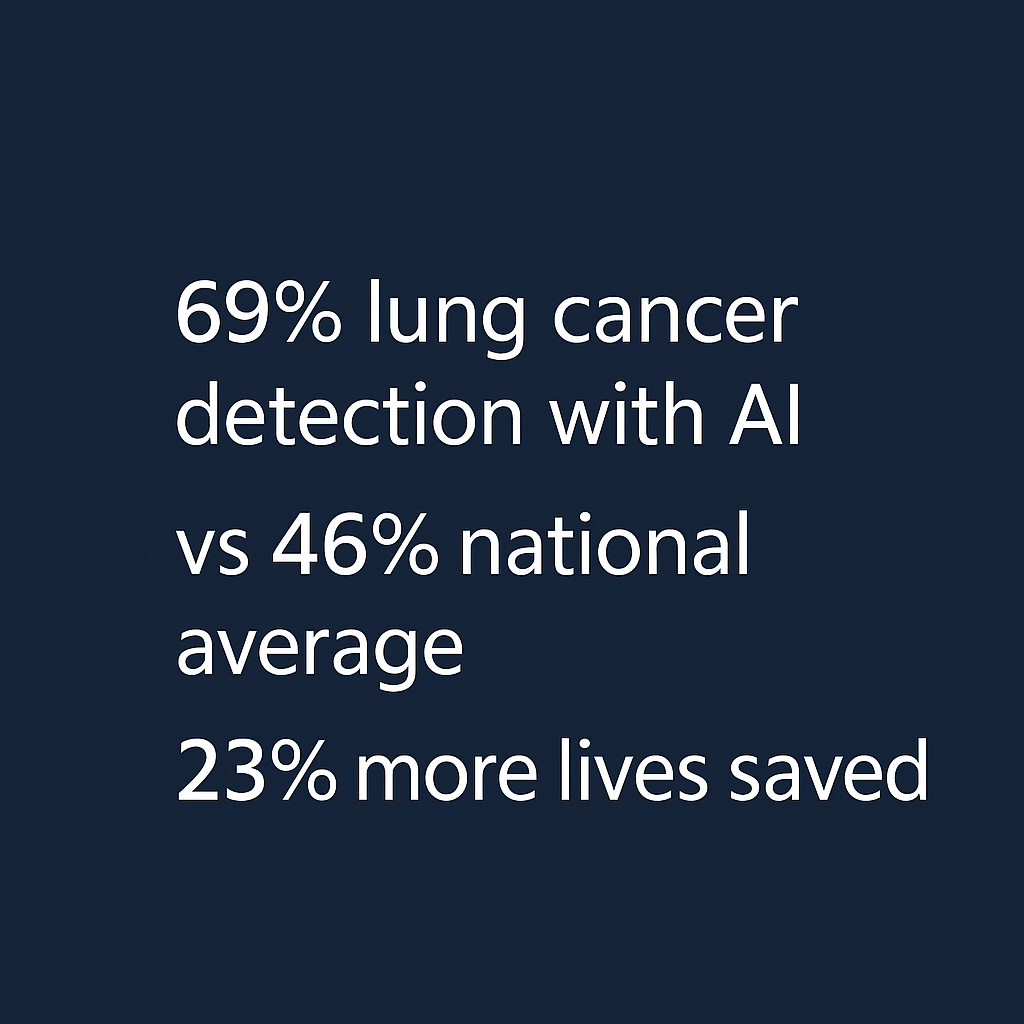
69% vs 46%. That's not a typo. That's the difference between Epic's Art AI catching early lung cancer and the national average. The Christ Hospital in Cincinnati just proved what happens when AI actually works in healthcare: lives saved, not just time. 🔍 Here's what makes this breakthrough different: Art doesn't replace radiologists. It scans every chest X-ray for incidental findings that human eyes might miss during rushed reads. When it spots a potential lung nodule, it automatically adds it to the patient record and schedules the follow-up. No alerts fatigue. No workflow disruption. Just catch cancer when it's actually treatable. Over 85% of Epic customers now use Art. Houston Methodist just expanded it to bedside nursing. Home care launches ...

Healthcare Supply Chain AI Revolution
The biggest healthcare supply chain innovation just dropped, and nobody's talking about it. Medline just became the first healthcare company to deploy AI robots that think, pick, and pack like humans. On April 16, they partnered with Symbotic to revolutionize how medical supplies reach your hospital. Think about this: • Autonomous robots that know exactly what your OR needs before you do • AI that maps every item to your hospital's specific layout • Zero human error in critical supply fulfillment Why does this matter? 🎯 Remember the PPE crisis? The formula shortages? The IV fluid disasters? Those weren't just pandemic problems. They exposed a supply chain running on 1990s technology while treating 2026 patients. Medline operates 45 distribution centers. ...
CMS MAHA ELEVATE Program for FQHCs
FQHCs just got a $100M shot at transforming Medicare care. CMS Innovation Center dropped MAHA ELEVATE this week: Make America Healthy Again through Enhancing Lifestyle and Evaluating Value-based Approaches Through Evidence. Here's what makes this different: Unlike traditional grant programs that fund incremental improvements, this 3-year cooperative agreement pushes FQHCs to integrate evidence-based lifestyle and functional medicine alongside standard care. The focus? Medicare populations drowning in chronic disease. Think about it: FQHCs serve 31 million patients, many with diabetes, hypertension, and obesity. Traditional 15-minute visits aren't cutting it. Now CMS wants to fund whole-person approaches that actually address root causes. 📊 The opportunity: • Up to 30 FQHCs selected • 3-year funding cycles • October 2026 launch • Focus on ...