Share this article and save a life!
Everyone is calling multi-cancer blood tests a breakthrough. They are missing the real story. 🔬
The hype is real. But so is the gap it exposes.
According to Duke Today, we currently have early screening tests for exactly five types of cancer: breast, colorectal, prostate, cervical, and lung. And every single one of those tests screens for only one cancer at a time.
That is the baseline we have been working from.
Now MCED tests, multi-cancer early detection, change the math entirely.
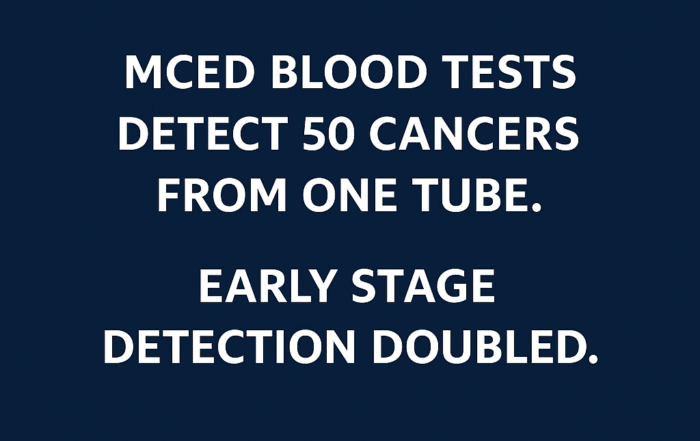
🔹 A single tube of blood can screen for up to 50 cancers.
🔹 The test detects cancer cells floating in the blood.
🔹 A positive result can identify the mutation within the DNA and the site of origin in the body.
🔹 Last year, the Galleri MCED test detected more than seven times as many cancers as standard screenings.
🔹 More than half of those cancers were found in early stages.
Seven times. Let that land.
For cancers like pancreatic, liver, and ovarian, there is no standard screening at all. None. Duke Health describes these as cancers for which there is no good screening. MCED tests are the first real answer to that problem.
Here is what I keep thinking about though.
Every conversation about this technology centers on the test itself. The science. The FDA review. The payer coverage dynamics. Those conversations matter.
But what about the patients who will never get the order written? The rural community sitting three hours from a specialist. The uninsured worker who skips the annual visit. The underserved population that barely gets the five existing screenings, let alone access to something new.
At Oatmeal Health, this is the exact problem we are trying to solve. We work on lung cancer screening, one of those original five. And even there, screening rates in underserved communities remain dangerously low. If we cannot close that gap for a screening test that has existed for years, we have to ask hard questions about who actually benefits when the next generation of tools arrives.
The MCED Access Checklist every provider should be thinking about:
1. Does your care team have a workflow to identify eligible patients proactively?
2. Are you reaching patients without established primary care relationships?
3. Do your referral pathways account for patients without transportation or insurance?
4. Is there a follow-up protocol when a test flags something and the patient goes silent?
Save this list. It matters more than the science press release.
The test is extraordinary. Early detection at scale can save hundreds of thousands of lives. But technology does not close access gaps on its own. People and systems and intentional effort do.
The question is not whether MCED tests work. According to Duke Health, they clearly do. The question is whether we will build the delivery infrastructure to make sure the people who need them most are actually the ones getting them.
👉 Follow Jonathan Govette, CEO of Oatmeal Health, for daily healthcare insights on LinkedIn. Deeper dives in The Oatmeal Bite on Substack: https://news.oatmealhealth.com
Share this article and save a life!
Author:
CEO/Co-Founder @ Oatmeal Health | AI Lung Cancer Screening | Almost Became a Doctor | Engineer | Follow to Share What I’ve Learned Along the Way
I help patients get the care they need earlier, preventing late-stage cancer.
That’s been the throughline across three companies and almost 20 years in healthcare. At ReferralMD, we fixed broken referral networks so patients didn’t fall through the cracks. At Oatmeal Health, it’s lung cancer: building the diagnostic and screening infrastructure so the 85% of cases caught too late get caught early instead.
Today as CEO of Oatmeal Health, I lead a team embedding AI into radiology workflows to turn routine lung CT scans into reimbursable cancer risk assessments. We partner with FQHCs to reach underserved communities, and with health systems and payers to make early detection economically sustainable. Think HeartFlow or Cleerly, but for lungs.
Between companies, I advised at Techstars and Plug and Play, mentoring founders building in digital health. That experience shaped how I think about what separates companies that ship from companies that stall: distribution, reimbursement, and clinical trust, not just technology.
I’m a CancerX alumnus, a 3x healthcare founder, and someone who believes the biggest problems in cancer aren’t scientific. They’re operational.
We’re hiring mission-driven builders at Oatmeal Health. If you want to work on something that matters, reach out.
When I’m not working, I’m traveling, mentoring, and keeping up with one very energetic husky. 🐾
Substack – The Oatmeal Bite:
Millions of patients get less care because of who they are, where they live, or how they look. I’m fighting to change that. CEO @OatmealHealth, a startup built for the underserved. The Oatmeal Bite: intel for clinicians, investors, and advocates.
Jonathan Govette
CEO of Oatmeal Health
Substack:
https://oatmealhealthjonathangovette.substack.com/