
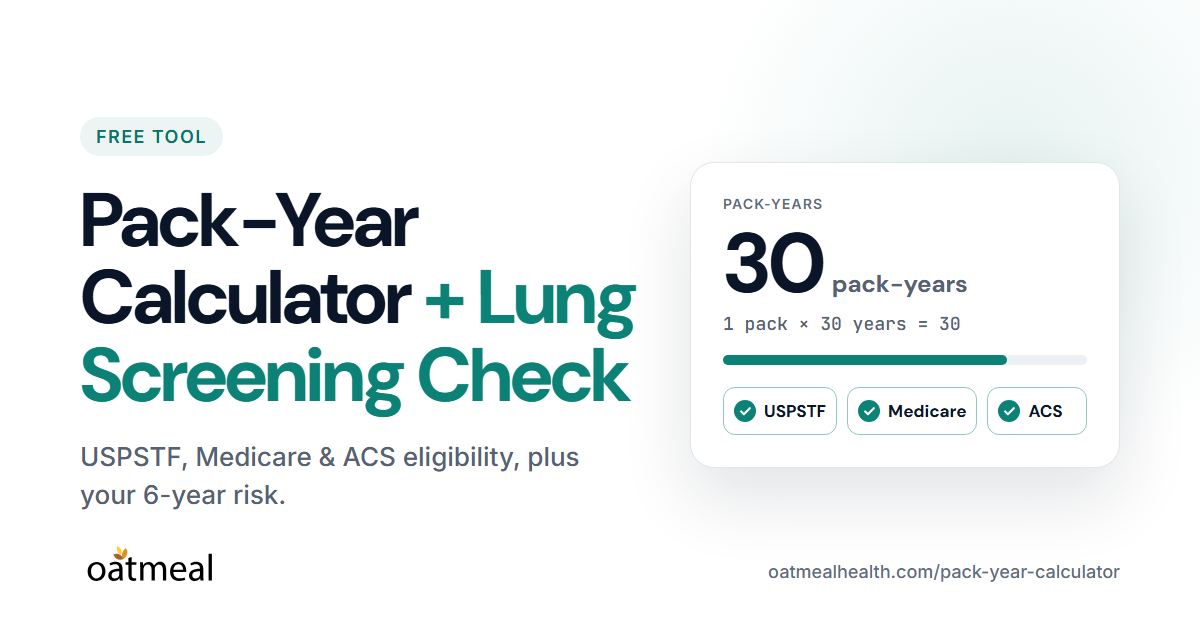
Free tool for patients and clinicians
Pack-year calculator and lung screening check
Calculate pack-years, check screening eligibility under USPSTF, Medicare, and American Cancer Society guidelines, and see your personal 6-year lung cancer risk with the published PLCOm2012 model.
- Private. Nothing you enter is saved or sent.
- USPSTF 2021, CMS 2022, ACS 2023
- Embed on your site, free
Pack-years
Enter how much and how long to see the math.
6-year lung cancer risk
Medicare requires this visit, using a decision aid, before the first screening scan. Check each item as you cover it. It is added to the chart note.
Patient prefers Spanish or Chinese? Switch language at the top of the page, then print.
Billing by setting (office, FQHC, telehealth): see the FAQ below.
Complete the fields to generate a note.
Checking one patient at a time? Smoking history is often scattered across EHR notes. LungIQ reviews your whole panel and flags patients who likely meet screening criteria. See how LungIQ works → Or try Find the Proof.
For education only, not medical advice. Lung cancer screening is for people without symptoms. If you have a new cough that won't go away, chest pain, coughing up blood, or unexplained weight loss, see a clinician now. Eligibility and insurance coverage can depend on factors this tool doesn't ask about.
Pack-year calculator by Oatmeal HealthSee benefits, harms, and the full guide →
Why screening matters
Is screening worth it for you?
Lung cancer is far more treatable when it is found early. Today, about half of lung cancers are found only after they have spread. A yearly low-dose CT scan is how it gets caught sooner.
Found early
65%survive at least 5 years when lung cancer is found before it spreads.
Found after it spreads
10%survive at least 5 years once it has reached other parts of the body.
With CT screening
7 in 10cancers found by screening CT in the NLST trial were early stage, compared with about 4 in 10 found by chest X-ray.
lung cancer deaths were prevented by yearly low-dose CT in the National Lung Screening Trial. A second large trial, NELSON, found 24% fewer lung cancer deaths among men who were screened.
Survival and stage at diagnosis: NCI SEER, lung and bronchus cancer, 2016 to 2022 (localized 65.5%, distant 10.5%; 51% diagnosed at distant stage). Screening stage: NLST incidence screens, Aberle et al., NEJM 2013 (stage I or II: about 69% with low-dose CT vs about 41% with chest X-ray). Deaths prevented: NLST, NEJM 2011; NELSON, de Koning et al., NEJM 2020.
What it looks like for 1,000 people like you
Picture 1,000 people with the same risk as you. This is roughly what happens over 6 years with and without yearly low-dose CT screening.
Example for a typical screening candidate at 2.5% risk. Fill in the calculator above to personalize.Without screening
12- Die of lung cancer
- Do not die of lung cancer
With yearly screening
10- Die of lung cancer
- Death avoided by screening
- Do not die of lung cancer
fewer lung cancer deaths per 1,000 people like you who get screened every year. In the NLST trial, screening lowered lung cancer deaths by 20%. The higher your risk, the more people screening helps.
Possible harms, for every 1,000 people screened
get a first scan result that needs follow-up but turns out not to be cancer. Most only need another scan.
have a biopsy or other procedure for something that turns out not to be cancer.
has a serious complication from a follow-up procedure.
of cancers found by screening may never have caused a problem (overdiagnosis).
Deaths are an illustrative estimate: 6-year PLCOm2012 risk × the share of lung cancers that were fatal in the NLST chest X-ray arm (443 of 941) × the 20% reduction seen with low-dose CT in NLST. Harms: USPSTF 2021 evidence review (Lung-RADS false positives 12.8%, invasive procedures after a false positive 1.7%, major complications about 0.1%) and CISNET modeling (overdiagnosis about 6% of screen-detected cancers). A low-dose CT gives about as much radiation as 6 months of natural background exposure.
The basics
What is a pack-year?
A pack-year is a way to measure how much someone has smoked over their lifetime. It combines how much a person smoked each day with how long they smoked.
One pack-year equals smoking one pack of cigarettes (20 cigarettes) a day for one year. Doctors use pack-years to estimate lung cancer risk and to decide who should get a yearly low-dose CT scan.
Definition: National Cancer Institute.
Worked examples
How to calculate pack-years
Divide cigarettes per day by 20 to get packs per day, then multiply by the number of years smoked. If smoking changed over time, calculate each period and add them up.
One pack a day for 20 years
The classic example, and exactly the threshold used by current screening guidelines.
1 pack × 20 years
= 20 pack-years
10 cigarettes a day for 30 years
Half a pack a day adds up over a long time. Light smoking for decades can still cross the threshold.
10 ÷ 20 = 0.5 packs
0.5 × 30 years = 15 pack-years
Smoking that changed over time
1.5 packs a day for 10 years, then cut back to half a pack for 12 years. Add the periods together.
1.5 × 10 = 15
0.5 × 12 = 6
15 + 6 = 21 pack-years
- Quit and started again? Count only the years spent smoking. Skip the years in between.
- Hand-rolled cigarettes are usually counted the same way as packaged cigarettes.
- Cigars, pipes, and vaping are not part of the pack-year formula used in screening guidelines, but they still matter. Tell your clinician.
- Not sure of exact numbers? A best estimate is fine. Clinicians ask for an approximate history too.
Who should get screened
Lung cancer screening guidelines compared
All three guidelines recommend a yearly low-dose CT scan for adults with at least 20 pack-years. They differ on the upper age limit and on how long ago someone quit.
| USPSTF2021 recommendation | Medicare (CMS)2022 coverage decision | American Cancer Society2023 guideline | |
|---|---|---|---|
| Age | 50 to 80 | 50 to 77 | 50 to 80 |
| Smoking history | 20+ pack-years | 20+ pack-years | 20+ pack-years |
| If you quit | Within the past 15 years | Within the past 15 years | Any time. No limit on years since quitting. |
| Other requirements | No symptoms of lung cancer | No symptoms. A counseling and shared decision-making visit before the first scan, and an order from a clinician. | No symptoms |
| Why it matters | Most private insurance plans cover screening for people who meet USPSTF criteria. | Sets coverage for people with Medicare. | Includes more former smokers. Coverage may vary. |
Sources: USPSTF, JAMA 2021; CMS National Coverage Determination 210.14, 2022; Wolf et al., CA Cancer J Clin 2024 (ACS 2023 guideline update). Full citations below.
For health systems and FQHCs
Pack-years, across your whole patient panel
This calculator checks one person. Oatmeal Health helps care teams find every patient who likely qualifies, guide them to screening, and support the radiologist's read.
Find the Proof · Playlist · Rounds 1 to 6
Can you spot a 20 pack-year history?
Six short rounds that play back to back. Each one shows a chart and asks one question: does this patient qualify for lung cancer screening? See how often the answer is buried in a note or missing altogether.
1 · Find
LungIQ
AI reviews your EHR, including smoking history buried in clinical notes, and flags patients who likely meet screening criteria.
Explore LungIQ →2 · Guide
LungNAV
An AI patient navigator that calls patients in 70+ languages, explains screening, and hands them to your scheduling team.
Explore LungNAV →3 · Diagnose
LungAI
An AI second opinion on low-dose CT lung cancer screening scans, with a Malignancy Risk Score inside the CADe or PACS viewer radiologists already use.
Explore LungAI →LungAI is investigational and not FDA 510(k) cleared.
Methodology
How this calculator works
Every number on this page comes from a published formula or study. Here is exactly what the calculator does, what it assumes, and where it falls short.
Pack-years
- Formula: packs per day × years smoked. Cigarettes per day are divided by 20.
- Changing habits: each smoking period is calculated separately and added together.
- Age started option: years smoked = age stopped (current age, or age in the quit year) minus age started, minus years off.
Guideline eligibility
- USPSTF 2021: age 50 to 80, 20+ pack-years, currently smokes or quit within 15 years.
- Medicare (CMS NCD 210.14, 2022): age 50 to 77, same smoking criteria.
- ACS 2023: age 50 to 80, 20+ pack-years, no limit on years since quitting.
- Years since quitting are counted in whole calendar years, so results near a cutoff are approximate.
6-year risk (PLCOm2012)
- Model: PLCOm2012 logistic model, Tammemägi et al., NEJM 2013, Table 2. Coefficients were cross-checked against two independent open-source implementations.
- Smoking inputs: average cigarettes per day across all periods, total years smoked, and years since quitting.
- Defaults when a question is skipped: BMI 27, education "some college", the model's reference race group, and no COPD, prior cancer, or family history. The result says how many details were used.
- Developed in adults aged 55 to 74; estimates outside that range are less certain.
Benefits, harms, and limits
- Deaths avoided: 6-year risk × share of lung cancers that were fatal in the NLST chest X-ray arm (443 of 941) × the 20% reduction seen with low-dose CT. An illustrative estimate, not a prediction for one person.
- Harms: USPSTF 2021 evidence review and CISNET modeling, applied to everyone screened.
- Not included: symptoms, radon, workplace exposures, cigars, pipes, or vaping. This tool supports a conversation with a clinician and is not a diagnosis.
- Privacy: all calculations run in your browser. Nothing is stored or sent.
FAQ
Pack-year questions, answered
How do you calculate pack-years?
Multiply the number of packs smoked per day by the number of years smoked. If you count cigarettes, divide cigarettes per day by 20 first. For example, 30 cigarettes a day for 20 years is 1.5 × 20 = 30 pack-years.
Is 20 pack-years a lot?
Twenty pack-years is the smoking history at which USPSTF, Medicare, and the American Cancer Society recommend yearly lung cancer screening for adults 50 and older. It equals one pack a day for 20 years, or two packs a day for 10 years.
I quit more than 15 years ago. Can I still get screened?
Under USPSTF and Medicare criteria, screening stops once it has been more than 15 years since quitting. The American Cancer Society's 2023 guideline removed that limit, so it recommends screening for former smokers with 20+ pack-years regardless of when they quit. Insurance coverage may follow USPSTF, so ask your clinician and your plan.
Does Medicare cover lung cancer screening?
Medicare Part B covers a yearly low-dose CT scan for people aged 50 to 77 with no symptoms, a smoking history of at least 20 pack-years, who currently smoke or quit within the last 15 years, and who have an order from a clinician. A counseling and shared decision-making visit is required before the first scan. If you qualify, you typically pay nothing for the scan when the provider accepts assignment.
What is a low-dose CT scan?
A low-dose CT (LDCT) scan uses a small amount of radiation to take detailed pictures of the lungs. It takes only a few minutes, needs no needles, and is the only recommended test for lung cancer screening.
Do cigars, pipes, or e-cigarettes count?
Screening guidelines use cigarette pack-years, so cigars, pipes, and e-cigarettes are not part of the calculation. They can still affect lung health, so mention them to your clinician.
Is lung cancer screening worth it?
It depends on your risk. In the National Lung Screening Trial, yearly low-dose CT lowered lung cancer deaths by 20% among people with a heavy smoking history. People at higher risk gain the most, while everyone screened faces some chance of false alarms and follow-up tests. The benefits and harms section above shows the numbers for people with your risk.
What is the PLCOm2012 risk model?
PLCOm2012 is a published lung cancer risk model (Tammemägi et al., New England Journal of Medicine, 2013). It estimates the chance of being diagnosed with lung cancer in the next 6 years using age, education, BMI, COPD, personal and family cancer history, race or ethnicity, and smoking intensity, duration, and years since quitting. Screening programs in England and Ontario, Canada use it to decide who to invite, with thresholds such as 1.51% or 2% over 6 years. It was developed in adults aged 55 to 74, so estimates outside that range are less certain.
Can clinicians use this for the Medicare shared decision-making visit?
Yes. Medicare requires a counseling and shared decision-making visit, using one or more decision aids, before a patient’s first screening scan. In the clinician view, this calculator checks eligibility, shows personalized benefits and harms, prints a one-page decision aid in English, Spanish, or Chinese, and adds a checklist of the required elements to the chart note. Clinicians remain responsible for the visit and its documentation.
How is the shared decision-making visit billed?
For Medicare, the visit is HCPCS G0296 and the screening scan is CPT 71271, with no coinsurance or deductible. In a physician office it can be billed the same day as another visit with modifier 25. In an FQHC or RHC it is a standalone visit, but it is not paid separately if billed the same day as another visit there. It can be done by telehealth (modifier 95, or 93 for audio-only), and Medicare’s home and audio-only flexibilities run through December 31, 2027. Medicaid coverage and rules vary by state, and private plans cover the scan without cost sharing but may handle the counseling visit differently. Claims need a smoking diagnosis code (Z87.891 or F17.21x). Information as of October 2026; verify with your Medicare contractor or payer.
Does this calculator save my information?
No. Everything is calculated in your browser. Nothing you type is stored or sent to Oatmeal Health or anyone else.
Where can I get help quitting?
Call 1-800-QUIT-NOW (1-800-784-8669) for free support in every U.S. state, or visit smokefree.gov. Quitting at any age lowers your risk.
Sources
- US Preventive Services Task Force. Screening for Lung Cancer: US Preventive Services Task Force Recommendation Statement. JAMA. 2021;325(10):962-970. uspreventiveservicestaskforce.org
- Centers for Medicare & Medicaid Services. Screening for Lung Cancer with Low Dose Computed Tomography (LDCT), NCD 210.14. Decision memo, February 2022. cms.gov
- Wolf AMD, et al. Screening for lung cancer: 2023 guideline update from the American Cancer Society. CA Cancer J Clin. 2024;74(1):50-81. doi.org/10.3322/caac.21811
- National Cancer Institute. Definition of pack year. NCI Dictionary of Cancer Terms. cancer.gov
- Medicare.gov. Lung cancer screenings. medicare.gov
- Tammemägi MC, et al. Selection criteria for lung-cancer screening. N Engl J Med. 2013;368(8):728-736. nejm.org
- National Lung Screening Trial Research Team. Reduced lung-cancer mortality with low-dose computed tomographic screening. N Engl J Med. 2011;365(5):395-409. nejm.org
- National Cancer Institute SEER Program. Cancer Stat Facts: Lung and Bronchus Cancer (5-year relative survival by stage, 2016 to 2022). seer.cancer.gov
- Aberle DR, et al. Results of the two incidence screenings in the National Lung Screening Trial. N Engl J Med. 2013;369(10):920-931.
- de Koning HJ, et al. Reduced lung-cancer mortality with volume CT screening in a randomized trial (NELSON). N Engl J Med. 2020;382(6):503-513.
- Jonas DE, et al. Screening for Lung Cancer With Low-Dose Computed Tomography: Updated Evidence Report and Systematic Review for the USPSTF. JAMA. 2021;325(10):971-987.
- Meza R, et al. Evaluation of the Benefits and Harms of Lung Cancer Screening With Low-Dose Computed Tomography: Modeling Study for the USPSTF. JAMA. 2021;325(10):988-997. pmc.ncbi.nlm.nih.gov
Guideline criteria last checked October 2026.