Share this article and save a life!
A surgeon in Rome removes the lower lobe of a pope’s right lung. 🫁 The Vatican calls the surgery successful, no complications, cancer caught at a very early stage.
That news traveled around the world in hours. And buried inside it was the statistic that keeps me up at night.
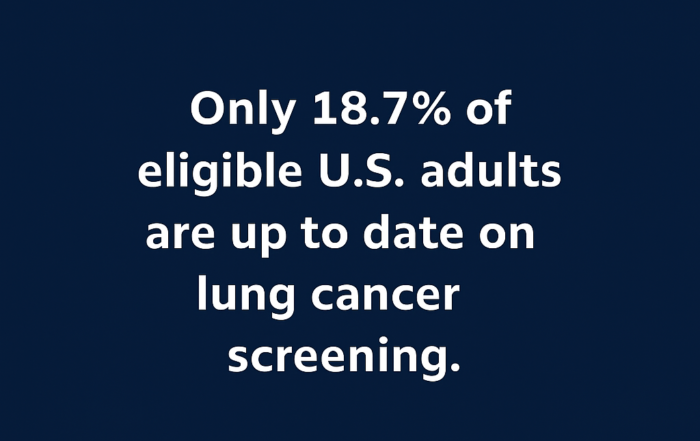
According to Managed Healthcare Executive, only 18.7% of U.S. adults eligible for lung cancer screening are up to date. That is fewer than 1 in 5. Out of 12.76 million people who qualify, the vast majority never get the scan designed to find this disease early.
Pope Leo XIV is 71 and reportedly not a smoker. His nodule was found incidentally during routine medical checks. He had access, follow-through, and a surgical team in Rome. The outcome: localized adenocarcinoma, resected, prognosis favorable.
Most eligible Americans have none of that chain working for them.
🔹 12.76 million U.S. adults currently meet federal lung cancer screening criteria
🔹 Only 18.7% of them report being up to date on screening
🔹 A separate JAMA study found 65% of eligible adults had a mammogram, versus about 18% for lung cancer screening
🔹 If every eligible adult were screened: roughly 62,110 lung cancer deaths prevented over five years and 872,270 years of life gained
🔹 At current rates: only about 14,970 deaths prevented and 190,030 years of life gained
That gap between 62,110 and 14,970 is not a clinical failure. It is a structural one.
The barriers named in the article are familiar to anyone building in this space: cost, coverage, prior authorization, no proactive outreach, and a deep layer of stigma. Patients who smoked often tell clinicians, “I did this to myself.” That fatalism keeps them out of clinics even when the test exists and works.
💡 The Lung Screening Gap Framework: three distinct failure points health plans and community health centers must address simultaneously.
1. ELIGIBILITY IDENTIFICATION. Most eligible patients are never flagged. No outreach, no risk stratification, no proactive query.
2. ACCESS AND COST REMOVAL. Annual LDCT is covered under the ACA for eligible adults, but administrative friction, prior auth, and cost confusion keep patients away.
3. STIGMA NAVIGATION. Provider awareness and patient counseling must address the “I caused this” narrative head-on before a referral is ever made.
If you work in population health, care coordination, or FQHC operations and are trying to build a screening outreach program, bookmark this framework. The article in MHE is worth the full read.
Lung cancer remains the leading cause of cancer death in the U.S. The American Cancer Society estimated about 225,000 new cases and 125,000 deaths from the disease in 2025.
At Oatmeal Health, we exist precisely because the pope’s experience, early detection during routine care, is not the standard for underserved Americans. It should be. The technology, the evidence, and the eligibility criteria already exist. What is missing is the structured, proactive pipeline that reaches patients before they show symptoms.
A world leader’s diagnosis renewed that conversation this week. The question is whether we let the news cycle move on, or we use this moment to actually fix the pipeline.
👉 Follow Jonathan Govette, CEO of Oatmeal Health, for daily healthcare insights on LinkedIn. Deeper dives in The Oatmeal Bite on Substack: https://news.oatmealhealth.com
Share this article and save a life!
Author:

CEO/Co-Founder @ Oatmeal Health | AI Lung Cancer Screening | Almost Became a Doctor | Engineer | Follow to Share What I’ve Learned Along the Way
I help patients get the care they need earlier, preventing late-stage cancer.
That’s been the throughline across three companies and almost 20 years in healthcare. At ReferralMD, we fixed broken referral networks so patients didn’t fall through the cracks. At Oatmeal Health, it’s lung cancer: building the diagnostic and screening infrastructure so the 85% of cases caught too late get caught early instead.
Today as CEO of Oatmeal Health, I lead a team embedding AI into radiology workflows to turn routine lung CT scans into reimbursable cancer risk assessments. We partner with FQHCs to reach underserved communities, and with health systems and payers to make early detection economically sustainable. Think HeartFlow or Cleerly, but for lungs.
Between companies, I advised at Techstars and Plug and Play, mentoring founders building in digital health. That experience shaped how I think about what separates companies that ship from companies that stall: distribution, reimbursement, and clinical trust, not just technology.
I’m a CancerX alumnus, a 3x healthcare founder, and someone who believes the biggest problems in cancer aren’t scientific. They’re operational.
We’re hiring mission-driven builders at Oatmeal Health. If you want to work on something that matters, reach out.
When I’m not working, I’m traveling, mentoring, and keeping up with one very energetic husky. 🐾
Substack – The Oatmeal Bite:
Millions of patients get less care because of who they are, where they live, or how they look. I’m fighting to change that. CEO @OatmealHealth, a startup built for the underserved. The Oatmeal Bite: intel for clinicians, investors, and advocates.
Jonathan Govette
CEO of Oatmeal Health
Substack:
https://oatmealhealthjonathangovette.substack.com/